Wednesday, January 22, 2014

War on the Final Frontier


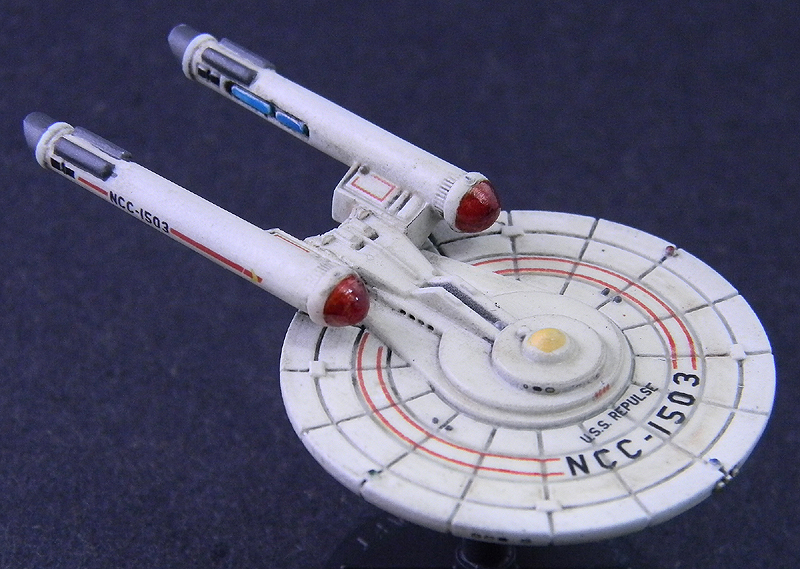
A number of years ago - just a bit longer than a generation - a number of independent companies began the privately funded colonization of the Arucanis Arm.  This remote section of space is believed to contain a number of species and civilizations that the Federation has yet to contact.  Needless to say, the Federation government was alarmed but at the time its leaders decided to respect the right of the colonists, who were mostly humans but with a few members of other Federation species, to self determination.

But war does strange things to people, and the war with the Klingons has gone on longer than any in the Federation expected.  The current stalemate as well as rumors that the Klingon empire is seeking an alliance with the Romulans have made the Federation council desperate.  They have begun seeking their own allies in unlikely places, and a number of council members believe that it is time someone investigate the situation in the Arucanis Arm.

The Arm lies in an extremely strategically important are where the initial Klingon advance at the beginning of the war managed to create a sliver of Klingon occupied space between the Federation and the semi-independent colonies.  If the colonies and unknown civilizations of the Arm could be convinced to join the Federation in the war, the Klingons' main supply lines to the front would be severed.

You are the crew of the USS Reliant and your mission is to survey the systems Arucanis Arm, make contact with the colonists as well as the unknown species, and convince them to join the war against the Klingons.  The Reliant is a New Light Cruiser, a wartime design that provides a not inconsiderable amount of firepower at a relatively low cost.  Unfortunately, this is possible due to the fact that much of the crew amenities have been stripped out, and thus this assignment is more spartan than a Federation exploration or battle cruiser.  However, the Reliant was chosen for a very specific reason: the common nature of its class will mean that the Klingons are less alarmed by its crossing their borders into the Arucanis Arm.  The Federation feels that any other ship would likely tip the Klingons off to the purpose of the mission, and thus endanger it.

Starfleet has made contact with the company that settled the closest section of the arm, now a small merchant empire headed by one Harcourt Fenton Mudd, a criminal from Federation space and fairly recent arrival to the Arm.  How he came to be in charge of the company is as yet a mystery, but he has agreed to help the Federation in exchange for amnesty and possible asylum at some future point.  The aid he is willing to provide at this point does not include fighting men or ships, but his company can offer their space stations to the Reliant for refueling and shore leave.  Mudd is also adamant that Starfleet inform you that he has quite a few suggestions for the latter purpose.

----------------------------------

This posts premise and title is taken from the somewhat obscure game Protostar: War on the Frontier, which the internet consistently tells me is mediocre at best.  However, I thought it had a good setup for a game that would be easily adaptable for settings of most any genre, though sci fi is obviously the easiest for it to port to.  I have expressed it in terms of Star Trek rather than Traveller partly because I think those terms are more broadly familiar, and partly because I've had a deep desire to run Star Trek that coincides with, and to some degree predates, my recent Traveller mania.

If I were to keep it Trek, I'd almost certainly borrow from a number of "non-canon" sources including the material for Star Trek Phase II (the unaired series, not the fan series with the same name), the closely related Star Fleet Universe (including that ship design up there), FASA's Star Trek supplements, and the animated series.  I'm not sure what system I'd use.  The two options that I would be most likely to look at are a kitbashed Traveller converted for Star Trek shenanigans or FASA Trek itself.  The first has some advantages, namely that I know I like the system and I have a bunch of red, blue, and yellow d6s, but it would probably take the most work.  Having looked at FASA Trek recently I see a lot to like there, but I'd probably have to houserule the combat into basically being regular old BRP combat before I'd use it.

I could also use part of the Terran Directorate setting, exchanging the Klingons for [Click], but there are a number of adventure ideas I can think of for this that would work better with Star Fleet do-gooders.

Monday, January 13, 2014

My Nostalgia be Different


Last week, I did a bad thing.  I ran a game and it wasn't Traveller.   I was weak (and the home group was going to be missing its pilot), and so I repurposed an old Uz map, put in some bandits and some degenerate "elves," and put it in hex 2521 of the Elephand Lands.  In keeping with what I talked about a while ago, I used the last D&D Next playtest packet to run it, and we had a blast.

I probably wouldn't be talking about it, except that over at the Hill Cantons blog Chris did a post about a recent game he played and the nostalgia he felt in doing so.  Despite using a new system, I felt a lot of nostalgia as well, and weirdly about things that are essentially the opposite of what Chris describes.  I started with 3e and for most of my high school and college games used a weird mix of 3e and 3.5 (I had the 3e books and my players had 3.5 and I had no idea what the difference was).  The things that took me back, so to speak, were things like 4d6 drop low stats, barbarians as a class, and weird class/race combinations like dwarf ranger and tiefling cleric.

Certainly the setting and the play group had something to do with it - the people at the table were the same people I played some of my first games with back in high school, and I ran the Wilderlands for most of my undergrad college career - but there was something in the air that wasn't when I tried some of my OD&D/S&W experiments out with the same group.  They liked Uz, sure, but it didn't feel like this did.

I also found that D&D Next was able to evoke this certain special something without a terrible amount of rules complication - in fact, certain aspects of the system mirrored what I was already thinking of doing or had done with my Dark Country house rules.

Ah, but since I am Demogorgon (probably) I would not be true to myself if I was not also filled with lingering doubts and some small voice whispering "no! no! it is wrong!"  The thing that originally attracted me to OD&D and S&W was their mutability.  In 2008 when I started reading these blogs, Huge Ruined Scott - in contrast to his current "no setting information whatsoever" ethos - was first working on his Wilderlands of Darkling Sorcery and then his long lost Thool setting.  These were in uncountable ways different than what I had thought of as D&D while still feeling obviously like D&D settings, with ruins and adventurers and weird magic and stuff.  He took OD&D and banged it into something weird and idiosyncratic to Scott, and he did it with ease.

So I said I wanna do that, and did my own thing for the Hammer Horror set.  The Dark Country is, as I have often said, my baby, and running a fantasy game (or really any game) outside of it - despite my constant urge - ultimately always seems pointless.  But it has developed in ways that, while still fairly close to D&D, make it and D&D Next, or at least what my group seems to want out of D&D Next, like fitting a square peg in a round hole.

But - says my other, D&D Next liking head - the characters they made for the little test session seem easy to convert to the Dark Country.  The chaotic wizard and the dwarf ranger are acceptable untouched, and the half-orc barbarian whose adopted human father tried to burn him works just as well if he's some kind of riff off of the calibans from the 3e version of Ravenloft.  Maybe I can do this, thinks Aameul.  Ah, thinks Hethradiah, but your wife made a tiefling cleric of Braz Kazon, Battle God of Smoke.  That would be quite a bit harder...

A note on the top picture: my favorite book for 3e was Oriental Adventures, and when trying to find 3e art that made me nostalgic, I was lucky enough to find this illustration.  Not only does it make me nostalgic for 3e, but it always reminds me of a Chinese folk tale about a dragon who lived in a kingdom under the sea I heard in my rather bizarre 7th grade history class.  Any time I have a map with an ocean or lake on it, I always put some little underwater ruins there because of that exact story.  Unfortunately, I don't think any group in my games has ever had the water breathing spell.

Saturday, January 11, 2014

An Attempted Pictorial Dictionary of my Wilderlands

Barbarian

Goblins

Elf, Northern

Dwarf

Amazon

Wizard

Druid

Evil High Priest
Dark Elf (male)

Dark Elf (female)

Ghinorians (of Damkina)

Alryans (CSIO)

Tharabians

Karaks

Skandiks

Viridians (common soldiers)

Viridian (Black Adder)

Thieves

Orc

Ogres

Troll

Ghul

Ruins (Kelnorian)

Ruins (Ancients)

Dungeon

Orichalcans 

Ghinorans (Lenap)

\
Ruins (Orichalcan)


Gods (small)

Ranger

Ghoul

Statue (animate)

Ruins (Elven)

Cleric

Minotaur

Wizard (high level)

Hydra

Viridians (archers with "magic" arrows)

Thursday, January 2, 2014

The Bureau of Astropsychics


Jump travel is incredibly hazardous.  Misjumps can see passengers spend thousands of years in jumpspace or have them "blown" off course by thousands of light years.  During the early days of Terran space travel, when much of known space was still unexplored, there was little guarantee that the destination you were jumping to would have a source of fuel to allow one to jump back or a habitable planet to allow ships to resupply.  Certainly there were a number of electronic mechanisms designed to detect suitable planets, but due to the fact that these relied on light to gather their information, they often showed only what a given system was like hundreds or thousands of years in the past.

It was to solve this problem that the Directorate, or perhaps a Terran polity pre-dating the Directorate, created the first astropsychics.  By using the psychic potential of the human mind that had already been identified decades or even centuries earlier, astropsychics were able to create images of sections of unknown space as it currently was.  Thus, they could identify whether or not a planet still possessed water or a gas giant had remained relatively stable, thus ensuring the exploration ships would be assured of a return trip, barring other misjump issues.

Even the most powerful astropsychics are not omniscient, and thus over 96% of the galaxy remains uncharted, and areas such as the Boom Worlds have only been recently discovered through the use of "chaining."  Initially, this practice began when astropsychics would telepathically beam the portions of the galaxy they had mapped to the next astropsychic an a long line in order to prevent the psychics from collapsing from exhaustion.  Eventually the Bureau's non-psychic board decided that a system by which these astropsychics would be mentally linked and kept in quasi-suspended animation would both be more cost effective and would return results more quickly.  This technology eventually led to the creation of the polyminds used as astrogators in Directorate highliners, the massive ships used to make the incredible jumps necessary to reach the Boom Worlds and other fringe areas of the Directorate.  

Due to the potential for mental degradation and insanity, Ultra-Terrans are almost never subjected to the extreme forms of torture, drug regimens, and cybernetic enhancement required to create an astropsychic.  Instead the bureau relies on a steady stream of drifters, vagabonds, and convicts in order to fill their ranks.  The governing board of the Bureau, and most of its top members, are not themselves psychic, though they often possess certain cybernetic enhancements designed to shield them from the psychic powers of the lower members.

The average astropsychic - those which have not been merged into a polymind or driven mad - also possesses a number of skills that make them capable assassins.  The Bureau has been unable to figure out a way to only awake the psychic powers necessary for advanced astrogation, though it is unlikely that they desire to do so.  The Bureau sees itself as chronically underfunded, and it is a well known secret that to increase its funds they often train their astropsychics to be hired killers.  These are then leased out to various megacorps, noble houses, and merchant guilds to allow them to compete in the microwars permitted by the Steering Committee in order to make sure the existing structure is "the fittest."  While this is technically illegal, the exalted status of the Bureau combined with the importance of their clients means they are likely never going to be prosecuted or reprimanded.


Sunday, December 29, 2013

What the Elephand Lands are Like

I tried to write this post in my more usual long form, but it wasn't working.  So here's this instead.


Precis: A cold, bitter frontier beset by inhuman enemies; fantasy Russia by way of Byzantium

Conspectus: Monomakos, the Overlord of the White Throne; ice age megafauna; dark forests crawling with the twisted results of failed experiments from the ancient elves tinkering with the now lost technology; the twisted, half-fish immortals in the service of His Piscine Majesty, the Viridian Emperor; tribes of fearsome Leiber-style "Ghuls;" Orcs! (it's been years since I've had them in one of my games); Kelnorian ruins in their marbled splendor crumbling in the cold snow; the remnants of Markrabian star-cruisers leaking "magic" into the surrounding area; blue "northern" elves; the ice wizards of Valon; demons trapped for millennia beneath glaciers; forest products; the screaming banshees of the Sidhe Hills; Rigorn the Magnificent, a Ghul Mage of terrifying power and mercurial mood;  The White Throne with its scrimshaw panels of mastodon tusk and tiger bone depicting the conquest of a people; Bullywug ruins in the marshes of the Greatflood River; cavemen morlocks and white apes, oh my!; amazons riding polar bears and sabertoothed tigers; a bitter but petty skirmishes along a long and wild border; strange pylons that create the warm weather found in the Land of Beasts, where dinosaurs roam free; the lost elven city in the mountain; cairns and barrows of a peoples lost to historical record; the whip-wielding disciples of the fish god Armadad-Bog; the cold bodies of dead gods of wood and stone who were dead before the first man walked the world

Taste; Sound; Image: "Winter's Wolves," Laketown from The Desolation of Smaug*


A Note on the new look: I decided changing the name of my blog temporarily would probably get confusing, and I liked the vaguely purple color scheme so I found another picture on my hard drive that fit it.

*I actually have some serious problems with this movie, and it's not very Tolkien, but its combination of cold town on a lake with medieval Russian looking guards mimicked what I was already thinking about for Damkina very well.


Thursday, December 26, 2013

In Places/Spaces Deep Plans for 2014

My parents went a bit overboard this Christmas

  • As I've mentioned a few times on G+ and on this blog, my chief goal is to have Traveller be my main game for 2014.
  • In that vein, I also want to do more to promote STARSLUGS.  A few of us who are planning to run Traveller games on G+ are trying to meet a couple of times to hash out how we want this thing to work.
  • Finish Feudal Anarchy.   This will probably include renewed attempts at a playtest campaign.  Stay tuned.
  • Get those guys in the top picture painted and killing each other.  I'm planning on using them as part of an imagi-nation project for the fake German polities of Rotland and Blauland (named after the two sides in the original Prussian wargames).  I'm not sure if I'm going to use Charge! or a modified version of By this Axe (With this Bayonet?) yet.
  • I also want to get my version of the Wilderlands closer towards being game ready.  This might have to wait until D&D Next is out (which I believe is sometime this summer).  As mentioned above, I'm not planning on running it this year, at least not as my main thing, but I do want to start hammering some stuff out.
  • I have a couple of ideas for space themed microgames I'm kicking around, including a card game designed to simulate Star Trek-style ship combat and one about playing raiders in a Foundation/Space Viking-like space-pocaypse.
  • Finally, I want to set up a reading list of Traveller-esque/applicable science fiction to spend the year reading.   I might do blog posts about what I thought about them when I'm done.  We'll see.

Sunday, December 22, 2013

Aliens(?) of the Directorate: Ultra-Terrans

Appearance and Biology
Ultra-Terrans are, technically speaking, humans, though the degree to which they have been genetically and cybernetically modified may make this fact seem incredulous to some observers.  They appear as aesthetically perfect humans, often with strangely colored skin or eyes or both.  They often possess redundant organs and other systems designed the help their human-like bodies cope with their decadent lifestyles.  Their DNA shows a great deal of "junk code," which act as special genetic markers, allowing them access to a number of services, institutions, and equipment unavailable to normal Directorate citizens.

History
Ultra-Terrans are the result of thousands of years of genetic experimentation on Sacred Terra, and they existed even before the founding of the Directorate.  Sometime before humans discovered the jump drive, the ancestors of Ultra-Terrans were able to use their money and influence to make themselves a class apart from ordinary Terrans.  Not content to hold their position through monopolizing force, wealth, and political rights as the nobles of Terran antiquity had done, those that would become Ultra-Terrans invested in technologies that would allow them to make their delusions of exceptionalism a reality.  It is believed that sometime during the colonization of the other planets of the Sol system, this led to a terrible war that saw the Ultra-Terrans cast down for a time, but with the creation of the Directorate's Steering Committee they were once again able to cement their position at the head of humanity.

Psychology
Ultra-Terrans are arrogant in the extreme, obsessed with decorum, and extremely competitive.  They seek to prove their superiority over other humans, other Ultra-Terrans, and other species in order to justify their position at the head of the galactic community.  Some Ultra-Terrans take on a paternalistic attitude towards normal humans, a fact that many of those so patronized find even more irritating than the normal mode of Ultra-Terran behavior.

Flavor
Ultra-Terrans are 40k space marines in a setting otherwise inhabited by Han Solos.  They also possess more than a dash of the inhuman strangeness that the nobles of Franke Herbert's Dune have, often to the exaggerated degrees seen in the David Lynch film.  Ultra-Terrans often engage in practices that are repulsive to nearly all humans, such as incest (or more often clone-cest) and cannibalism, having various modifications designed to negate the undesirable effects of these activities.  They are that knight from Jabberwocky... in Space!

Ultra-Terrans as Player Characters
One cannot make an Ultra-Terran character by choice, much as one cannot chose to enter the nobility.  If, while making a human character, you roll a high enough status to enter the nobility, roll 1d6.  If your Social Score is an A, you have a 1 in 6 chance of being an Ultra-Terran, if it is a B, a 2 in 6 chance, and so on.  Ultra Terrans add 2 to two of the following characteristics: Strength, Dexterity, Endurance, or Intelligence; however, no score may be brought above B/12 in this way.  In addition, the player must figure out a way in which their character looks eerily inhuman, such as "Dune eyes," cobalt colored skin, a complete lack of hair, etc.  The character also gets a silly space prefix applied to their title, such as Astroduke, Galactoviscount, or Metabaron.