Thursday, January 2, 2014

The Bureau of Astropsychics


Jump travel is incredibly hazardous.  Misjumps can see passengers spend thousands of years in jumpspace or have them "blown" off course by thousands of light years.  During the early days of Terran space travel, when much of known space was still unexplored, there was little guarantee that the destination you were jumping to would have a source of fuel to allow one to jump back or a habitable planet to allow ships to resupply.  Certainly there were a number of electronic mechanisms designed to detect suitable planets, but due to the fact that these relied on light to gather their information, they often showed only what a given system was like hundreds or thousands of years in the past.

It was to solve this problem that the Directorate, or perhaps a Terran polity pre-dating the Directorate, created the first astropsychics.  By using the psychic potential of the human mind that had already been identified decades or even centuries earlier, astropsychics were able to create images of sections of unknown space as it currently was.  Thus, they could identify whether or not a planet still possessed water or a gas giant had remained relatively stable, thus ensuring the exploration ships would be assured of a return trip, barring other misjump issues.

Even the most powerful astropsychics are not omniscient, and thus over 96% of the galaxy remains uncharted, and areas such as the Boom Worlds have only been recently discovered through the use of "chaining."  Initially, this practice began when astropsychics would telepathically beam the portions of the galaxy they had mapped to the next astropsychic an a long line in order to prevent the psychics from collapsing from exhaustion.  Eventually the Bureau's non-psychic board decided that a system by which these astropsychics would be mentally linked and kept in quasi-suspended animation would both be more cost effective and would return results more quickly.  This technology eventually led to the creation of the polyminds used as astrogators in Directorate highliners, the massive ships used to make the incredible jumps necessary to reach the Boom Worlds and other fringe areas of the Directorate.  

Due to the potential for mental degradation and insanity, Ultra-Terrans are almost never subjected to the extreme forms of torture, drug regimens, and cybernetic enhancement required to create an astropsychic.  Instead the bureau relies on a steady stream of drifters, vagabonds, and convicts in order to fill their ranks.  The governing board of the Bureau, and most of its top members, are not themselves psychic, though they often possess certain cybernetic enhancements designed to shield them from the psychic powers of the lower members.

The average astropsychic - those which have not been merged into a polymind or driven mad - also possesses a number of skills that make them capable assassins.  The Bureau has been unable to figure out a way to only awake the psychic powers necessary for advanced astrogation, though it is unlikely that they desire to do so.  The Bureau sees itself as chronically underfunded, and it is a well known secret that to increase its funds they often train their astropsychics to be hired killers.  These are then leased out to various megacorps, noble houses, and merchant guilds to allow them to compete in the microwars permitted by the Steering Committee in order to make sure the existing structure is "the fittest."  While this is technically illegal, the exalted status of the Bureau combined with the importance of their clients means they are likely never going to be prosecuted or reprimanded.


Sunday, December 29, 2013

What the Elephand Lands are Like

I tried to write this post in my more usual long form, but it wasn't working.  So here's this instead.


Precis: A cold, bitter frontier beset by inhuman enemies; fantasy Russia by way of Byzantium

Conspectus: Monomakos, the Overlord of the White Throne; ice age megafauna; dark forests crawling with the twisted results of failed experiments from the ancient elves tinkering with the now lost technology; the twisted, half-fish immortals in the service of His Piscine Majesty, the Viridian Emperor; tribes of fearsome Leiber-style "Ghuls;" Orcs! (it's been years since I've had them in one of my games); Kelnorian ruins in their marbled splendor crumbling in the cold snow; the remnants of Markrabian star-cruisers leaking "magic" into the surrounding area; blue "northern" elves; the ice wizards of Valon; demons trapped for millennia beneath glaciers; forest products; the screaming banshees of the Sidhe Hills; Rigorn the Magnificent, a Ghul Mage of terrifying power and mercurial mood;  The White Throne with its scrimshaw panels of mastodon tusk and tiger bone depicting the conquest of a people; Bullywug ruins in the marshes of the Greatflood River; cavemen morlocks and white apes, oh my!; amazons riding polar bears and sabertoothed tigers; a bitter but petty skirmishes along a long and wild border; strange pylons that create the warm weather found in the Land of Beasts, where dinosaurs roam free; the lost elven city in the mountain; cairns and barrows of a peoples lost to historical record; the whip-wielding disciples of the fish god Armadad-Bog; the cold bodies of dead gods of wood and stone who were dead before the first man walked the world

Taste; Sound; Image: "Winter's Wolves," Laketown from The Desolation of Smaug*


A Note on the new look: I decided changing the name of my blog temporarily would probably get confusing, and I liked the vaguely purple color scheme so I found another picture on my hard drive that fit it.

*I actually have some serious problems with this movie, and it's not very Tolkien, but its combination of cold town on a lake with medieval Russian looking guards mimicked what I was already thinking about for Damkina very well.


Thursday, December 26, 2013

In Places/Spaces Deep Plans for 2014

My parents went a bit overboard this Christmas

  • As I've mentioned a few times on G+ and on this blog, my chief goal is to have Traveller be my main game for 2014.
  • In that vein, I also want to do more to promote STARSLUGS.  A few of us who are planning to run Traveller games on G+ are trying to meet a couple of times to hash out how we want this thing to work.
  • Finish Feudal Anarchy.   This will probably include renewed attempts at a playtest campaign.  Stay tuned.
  • Get those guys in the top picture painted and killing each other.  I'm planning on using them as part of an imagi-nation project for the fake German polities of Rotland and Blauland (named after the two sides in the original Prussian wargames).  I'm not sure if I'm going to use Charge! or a modified version of By this Axe (With this Bayonet?) yet.
  • I also want to get my version of the Wilderlands closer towards being game ready.  This might have to wait until D&D Next is out (which I believe is sometime this summer).  As mentioned above, I'm not planning on running it this year, at least not as my main thing, but I do want to start hammering some stuff out.
  • I have a couple of ideas for space themed microgames I'm kicking around, including a card game designed to simulate Star Trek-style ship combat and one about playing raiders in a Foundation/Space Viking-like space-pocaypse.
  • Finally, I want to set up a reading list of Traveller-esque/applicable science fiction to spend the year reading.   I might do blog posts about what I thought about them when I'm done.  We'll see.

Sunday, December 22, 2013

Aliens(?) of the Directorate: Ultra-Terrans

Appearance and Biology
Ultra-Terrans are, technically speaking, humans, though the degree to which they have been genetically and cybernetically modified may make this fact seem incredulous to some observers.  They appear as aesthetically perfect humans, often with strangely colored skin or eyes or both.  They often possess redundant organs and other systems designed the help their human-like bodies cope with their decadent lifestyles.  Their DNA shows a great deal of "junk code," which act as special genetic markers, allowing them access to a number of services, institutions, and equipment unavailable to normal Directorate citizens.

History
Ultra-Terrans are the result of thousands of years of genetic experimentation on Sacred Terra, and they existed even before the founding of the Directorate.  Sometime before humans discovered the jump drive, the ancestors of Ultra-Terrans were able to use their money and influence to make themselves a class apart from ordinary Terrans.  Not content to hold their position through monopolizing force, wealth, and political rights as the nobles of Terran antiquity had done, those that would become Ultra-Terrans invested in technologies that would allow them to make their delusions of exceptionalism a reality.  It is believed that sometime during the colonization of the other planets of the Sol system, this led to a terrible war that saw the Ultra-Terrans cast down for a time, but with the creation of the Directorate's Steering Committee they were once again able to cement their position at the head of humanity.

Psychology
Ultra-Terrans are arrogant in the extreme, obsessed with decorum, and extremely competitive.  They seek to prove their superiority over other humans, other Ultra-Terrans, and other species in order to justify their position at the head of the galactic community.  Some Ultra-Terrans take on a paternalistic attitude towards normal humans, a fact that many of those so patronized find even more irritating than the normal mode of Ultra-Terran behavior.

Flavor
Ultra-Terrans are 40k space marines in a setting otherwise inhabited by Han Solos.  They also possess more than a dash of the inhuman strangeness that the nobles of Franke Herbert's Dune have, often to the exaggerated degrees seen in the David Lynch film.  Ultra-Terrans often engage in practices that are repulsive to nearly all humans, such as incest (or more often clone-cest) and cannibalism, having various modifications designed to negate the undesirable effects of these activities.  They are that knight from Jabberwocky... in Space!

Ultra-Terrans as Player Characters
One cannot make an Ultra-Terran character by choice, much as one cannot chose to enter the nobility.  If, while making a human character, you roll a high enough status to enter the nobility, roll 1d6.  If your Social Score is an A, you have a 1 in 6 chance of being an Ultra-Terran, if it is a B, a 2 in 6 chance, and so on.  Ultra Terrans add 2 to two of the following characteristics: Strength, Dexterity, Endurance, or Intelligence; however, no score may be brought above B/12 in this way.  In addition, the player must figure out a way in which their character looks eerily inhuman, such as "Dune eyes," cobalt colored skin, a complete lack of hair, etc.  The character also gets a silly space prefix applied to their title, such as Astroduke, Galactoviscount, or Metabaron.

Thursday, December 19, 2013

All I Want for Christmas is a Shambleau


In addition to the raw materials created by the Solar Event, traders in the Boom Worlds deal in a wide variety of exotic goods.  These are, of course, heavily regulated by the Terran Directorate.  However, there are a number of goods that are completely illegal under Directorate law, with only smugglers, aliens, and pirates to act as purveyors.  Below are a few of the more common, interesting, and exotic ones.

Terran Animals
Strangely, historical accident has created a situation where animals once native to Sacred Terra are now more common on the world Minerva than in the rest of the Directorate.  When the Guild of Redistricters decided to convert Terra into a Metroworld over a century ago, a number of Terran animals became "extinct," existing only as data collected on their respective genomes.  After the failure of the Athena Group's first colony on Prometheus, the megacorporation began researching the possibility of "resurrecting" these animals as part of a future terraforming attempt.  The results of this project can be seen on Minerva, which teems with ancient Terran animals such as zebras, tortoises, and gigarhinos.  These animals are often sought as pets by wealthy nobles, or occasionally simply for their pelts or other animal products.  However, the populations of these animals are tightly controlled on Minerva, and tampering with their numbers by hunting or capturing them is completely forbidden.

Psychic Frontal Lobes
A recent fad among the minor nobility of the Directorate - those that lack the genetic markers and cybernetics that distinguish the nobility of Sacred Terra - is to consume the right front lobe of aliens, and sometimes even humans, believed to have possessed psychic potential.  The goal behind this activity is obvious.  Unfortunately, a huge market of "fakes" has grown up to satiate the demand for lobes.  Many unscrupulous smugglers simply sell non-psychic lobes or those of non-sophants with unusually large brains.  In any event, it is the official position of the Bureau of Astropsychics, as well as the High College of Medicine that this practice is inefficacious.  The Low College of Medicine and the Board of Epicures is still holding debates on the subject.

"Juice"
This strange substance is rarely seen in Directorate controlled space.  Its precise nature is a mystery to Directorate authorities, but it seems to only be used by the mutant populations of the Boom Worlds, mutant or otherwise.  Its illegality is due to the fact that its production seems to be linked with the kidnapping of healthy terrans.

Rejuvenex
This anti-aging drug was created by Asklepios Pharmaceuticals, a megacorp that was purchased by the Athena Group a little over a year ago.  It supposedly relies on substances found only on worlds with ruins from Interstellar Empire present on them.  It was taken off the market after several users, began to show symptoms similar to the mutagenic properties of the Boom Worlds.  Still, desperate and vain minor nobles and merchants often desire the drug, believing that they will not gain mutations in the same way that the second wave of Boom Worlds settlers have not gained mutations from whatever energies caused them in the first wave.  The Kruelians have taken up the manufacture of a coarse, unrefined form of the drug that is more cheaply available.

Xamblai
These strange creatures appear similar to females of a large number of species, purportedly due to their ability to shape shift.  They are supposedly capable of giving their "owner" all manners of physical and psychic pleasure, but it is well known that the eat the life force of those who utilize their... services.  Unlike other natives of the Boom Worlds, they do not have any significant populations of mutants, leaving Directorate scholars to conclude that they are foreigners, perhaps from the same sector as the Ningaubles.  They are often traded as commodities by Kruelians and [Click]s, thus their inclusion here.

Wheat
Most consumables on Directorate worlds consist of meat animals, nutrient-sludge, and occasionally the edibles native to nearby garden planets.  However, recently a movement towards culinary "primitivism" has started on a number of high population and non-agricultural worlds.  These people desire a large amount of the ancient Terran grain known as wheat, which is still farmed on a large number of Directorate worlds.  However, the Directorate uses this grain to create the foodbars used by their armed forces and most spacers, and thus normally has a monopoly on the substance.  A few enterprising smugglers have begun moving wheat to feed the growing market for bread and biscuits in Directorate space.

Clicking this link will take you to a table showing the availability and prices of these goods.  Xamblai are not included because they are typically sold as individuals or small groups, not by the ton.

New Look for a New Year

As part of a cheap trick to shame myself into running the same thing for a year, I've decided for a temporary re-configuring/re-naming of the blog for 2014.

I want 2014 to be the year of Traveller and STARSLUGS, so let's hope I can make that happen.  I'll still probably be posting D&D stuff as I work on that on the side, but the goal is to make my Traveller campaign, both at home and on G+, last the whole year.

Not a very long post, but here's a song I guess:


Monday, December 16, 2013

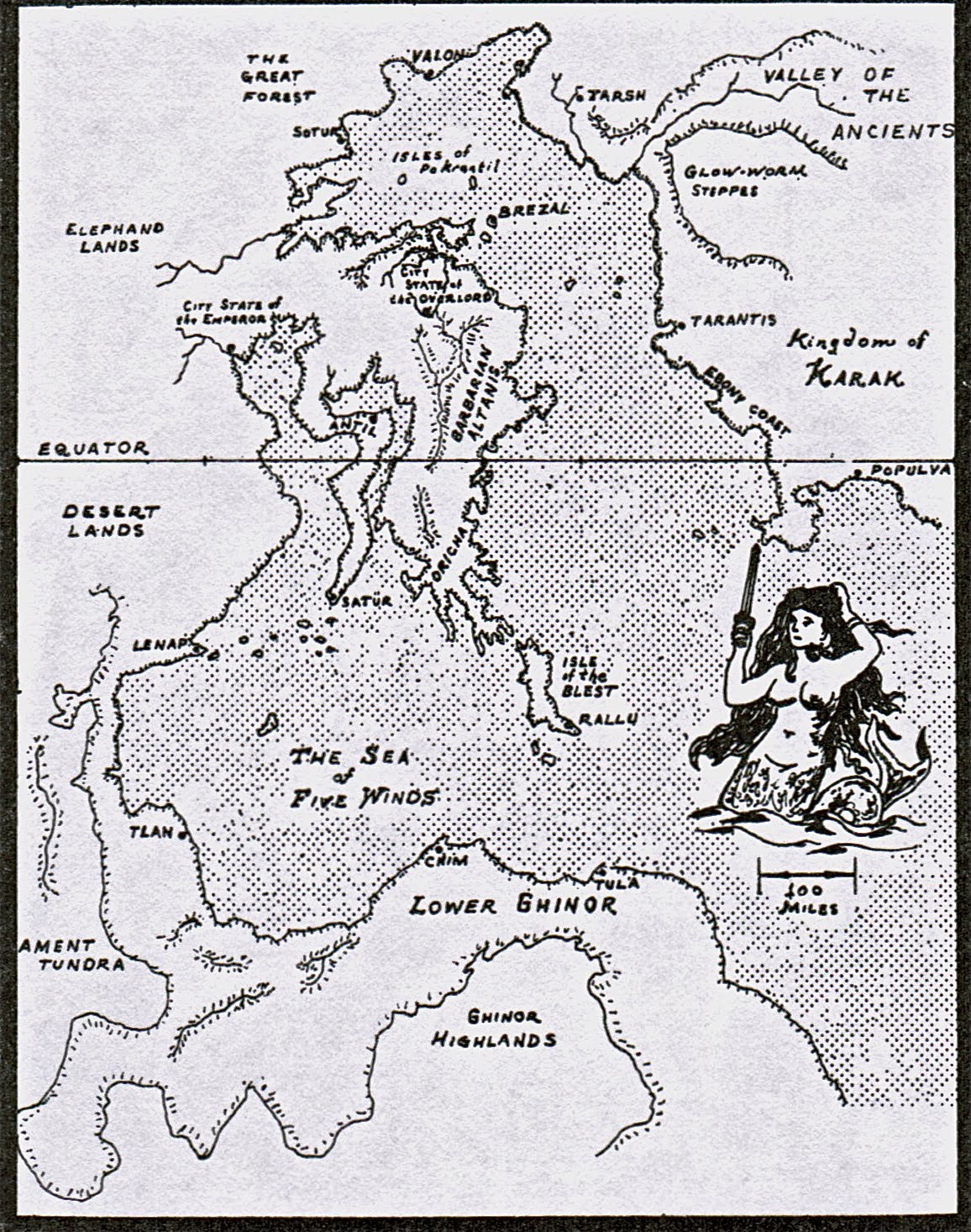
Notes on the Wilderlands of Swords and Wizardry

I decided that I will actually run a (heavily modified) version of the Wilderlands for my home group.  It will be based on the events of my early college campaigns, as well as some other stuff I think is neat.  You will notice some "misspellings" in the text below.  These represent my initial mispronunciations of certain words (Pazidun Peninsula, Tharabians, etc.) based on my semi-dyslexic reading of the original setting.


The City State of the Invincible Overlord
The City State of the Invincible Overlord was all but destroyed many years ago when a great automaton, a relic of the Uttermost War, erupted from the Earth and attacked the city.  The thing was stopped by a group of adventurers, who have since passed into legend and are sometimes revered as a kind of mini-pantheon known as the Comitatus.  The overlord of the past several years, Bjorn the Mighty, a Skandik demi-god rumored to himself be a member of the Comitatus, has rebuilt the city and brought the Skandik kingdoms of Ossary and Croy to heel.  The culture of the CSIO is largely based on 3rd century Rome, with Tharabian and Skandik troops acting as auxiliaries in its legions.  It is still primarily a city state, and Ossary, Croy, and the other kingdoms within its influence are protectorates, not provinces.

The Empire of Vridistan (the City State of the World Emperor)
Viridistan acts as the chief rival to the CSIO.  The Viridian Emperor's territory is apparently large, streatching from the Desert Lands to the Elphand lands, and having recently acquired some lands in the Eastern part of the Roglaras when the CSIO was being rebuilt.  However, his grip over these areas is weak, and the individual satraps possess a great deal of power.  As the name and some of the nomenclature hints at, the Viridians resemble the Achaemenid Persians culturally, complete with Immortals.  However, the Viridians are a tiny, disappearing minority and the bulk of the population is Tharabian (Celtic) or Ghinorian (Greek).

Barbarian Altanis
Conan, or perhaps Konahn, land.  The barbarians here have skin of vaguely red or violet hues, showing their possible relationship to the ancient Orichans of old.  They often raid into the lands of Viridistan and the Skandiks.

Antil
Antil is the City of Slavers and primarily serves as generic sword & sorcery bad guy fodder.  They are bald and tend to eschew the historical armor more commonly found in the other areas of my Wilderlands for stupid Red Sonja bad guy style get ups.

Oricha
The Kingdom of Oricha once stretched the entirety of the Pazidun Peninsula.  Its rulers were said to be men descended from demons with blood red or violet skin and raven black hair.  Their descendents supposedly live on in Barbarian Altanis, but their culture was destroyed long ago during the rise of the Kingdom of Kelnore and the arrival of the Tharbrians to the Roglaras.  It is thought by some that the CSIO may have been Oricha's capital.  Their culture and ruins are vaguely Egyptian in a kinda weird, Hollow Earth conspiracy theory sort of way.

Ghinor
Ghinor is the common tongue's name for the ancient Kingdom of Kelnore, which at its height stretched almost across the entirety of the Wilderlands.  The kingdom fell, much like Oricha, with the rise of two new kingdoms (Viridistan and Tarantis) and the arrival of barbarians (the Skandiks).  The southern areas of the Wilderlands still possess a number of Ghinorian successor states, most of which have either pseudo-Hellenistic cultures (though some may be more like early Byzantine).

Elphand Lands
This frozen land marks is dominated by the Elphand Province of Viridistan, a rather rebellious region that is notoriously difficult to run.  It is sometimes given to extremely competent satraps in the hopes that they will be able to cement Viridian influence there, and sometimes given to those out of favor with the Emperor as a sort of exile.  The northernmost section remains independent, and the city of Damkina - an isolated Ghinorian successor state with a vaguely Kievan Rus-style culture - has, on a few occasions, been able to rally the northern villages together to resist Viridian incursions.

The Great Forest
This large section of the Elphand lands was once home to a great Elven empire, created supposedly only shortly after the Uttermost War, though times the chronology for events that distant is often hard to pin down.  It is now home to a few petty elf kingdoms and a strangely large number of cave-men, morlocks, and other strangely-human like beasts.

Valon
Valon was once an outpost of the Elven Kingdom of the Great Forest, though now it is mainly ruled by men (and a large number of half-elves).  These men share the blue skin of the Northern elves, hinting at their mixed ancestry.  It is a beacon of civilization in an otherwise barbaric wilderness, though this means it is also vulnerable to the excesses of Wilderlands civilizations, particularly slavery.  Like the Tharabians, Avalonian culture is vaguely Celtic, though perhaps more reminiscent of medieval Ireland than the Gauls.

Tarsh
Tarsh is a largely ruined city that once stood at the head of a great kingdom in the North. It was once a protectorate, though not a direct part, of the Kingdom of Kelnore.  When combined with its strange, star-gazing druids, the overall effect is rather like Mithridatic Pontus.  With the collapse of the Ghinorians in the face of other kingdoms and barbarians, the strange priests of Tarsh turned inwards to investigate the magical properties of the heavens and of bizarre gates that liter the area. 

The Valley of the Ancients
This infamous valley is filled with ruins that predate even ancient Oricha, some even going back before the Uttermost War.  This is where you get ray guns.

Tarantis
Tarantis is a vaguely Seljuk protectorate of the Kingdom of Karak, known for its pirates and occasionally for its Sinbad-style sailors.

The Kingdom of Karak
Karak is a vaguely Mongolian kingdom whose territories in the Wilderlands include Tarantis and the Ebony Coast.  While the urban centers of their kingdom tend to be in the south, the Karakhans themselves spend much of their time on the Glow Worm steppes, where they keep their horses and live their traditional nomadic lifestyles when not holding court. 

The Desert Lands
This is another rebellious province of Viridistan, centered around the Holy Cities of Mycr, a strange monotheistic deity rarely worshiped outside these lands.  Mycretians loathe the Viridians but their priests urge pacifism, leading to a number of odd forms of resistance.  The holy cities are supposedly connected by miles of underground passages, complete with shrines and even a sacred fire sometimes purported to be Mycr himself.

Lenap
A Ghinorian successor state at the edge of a steaming jungle, Lenap is very similar to the Ilionians of Uz - that is, they are Greeks who have a large number of strangely Mayan affectations as well as a cultural fascination with dinosaurs.

I'm probably going to redraw the map immediately around the campaign area (haven't decided if that's going to be the CSIO or not yet), replacing or renaming settlements in order to make the aforementioned cultures show up more clearly.  I like the Wilderlands, but I think it suffers from being nonsensical culturally unless the DM puts some extra work into it.