Showing posts with label lost worlds. Show all posts

Sunday, March 4, 2012

Lost Worlds Part 2: Dungeons and the Lost World

When I initially thought about turning this into a series of posts, I thought I would save this one until the end.  Now I've decided that I'm not going to get anywhere unless I talk about the most obvious example of lost worlds in a D&D context: dungeons.

There are a few published examples of this idea, notably B4: the Lost City and Caverns of Thracia.  These modules take place in dungeons that are the ruins of some lost civilization, and the inhabitants of these ruins still retain a degenerate version of that civilization's culture.*  On the surface it might appear as though this describes most dungeons; however, it is easy to think of counter examples such as T1: the Village of Hommlet or the B2: the Keep on the Borderlands.

So what makes one dungeon a lost world dungeon and another one just a "regular" dungeon?  This might seem like a simple question, but it's worth thinking about.  The most obvious answer lies in the explanation for the dungeon itself.   The Lost City once belonged to a culture unknown to the broader world, and outsiders have not set foot in it for quite some time.  The moathouse is simply a... well... moathouse that some bandits/cultists have decided to use as a base of operations.  While not a shabby setup, the moathouse lacks the exotic mystery of the Lost City.**  They're essentially in two different genres.

But that's not all that makes a Lost World dungeon, or at least it shouldn't be.  Part of what makes these settings so fascinating is that they contain wonders that are hidden away from the larger world.  This can be difficult to convey in a magical milieu such as the one that is the default assumption of the D&D rules, but it is not impossible.  The easiest way to do it, to my mind, is to fill your dungeon with new or extremely underused monsters.  If your lost world just has the same old orcs the surface world does, it doesn't feel very "lost."  Grimlock/morlock cultists who sacrifice captured surface-dwellers to their albino dinosaur-god are better.

Try to think about what the original civilization/world was like and how being isolated in the subterranean depths has changed it.  I like to imagine what horrors would "evolve" down there and how the new environment might affect the more humanoid inhabitants, if any.  What do the people eat?  Do they have any domesticates they created since being cut off?  What nameless things stalk the less patrolled parts of their domain?  Now, I'm not arguing for a fully fleshed out ecology, but I cannot deny that thinking about these sorts of questions can spark ones imagination.  A good rule of thumb is that the more fucked up the answer is the better it will be at contrasting with the surface world the PCs are used to.

As far as I'm concerned, I can think of no better premise for a megadungeon.  It'd be easy to have different factions, such as the cults found in B4, and if the alien wonders of such a setting can't excite your players then you should probably find new ones.  However, I would caution against a more "underdark" style setup in which the cavernous world spreads across the entire planet.  For one thing, this makes the area the players are exploring a little less unique, and the underground monsters just become part of an equally large ecosystem.  It turns a place of nightmare into just another environment like a jungle or desert.

This isn't to say that all such dungeons have to be the size of the Lost City.  In fact, I find the size of that module a little constraining.  Where are my lost seas and subterranean suns?  Instead, you should make sure that your lost world dungeon is closed off from the influences of both the surface and other, hypothetical lost worlds.  This allows you to make it unique without having to explain how that interacts with something else.

One final bit of advice, and one I find much less necessary than the above bits, is to make the surface world either a fantasy version of historical Earth or an analog thereof.  Now, don't make the surface world "mundane" unless you plan on setting every single session in the lost world,*** but having something that looks a bit more familiar to the players as the baseline allows them to contextualize the weirdness a bit better. One way to do it might be to have the surface world resemble a kind of medieval romance.  Surface adventures have dragons and maidens and black knights and haunted castles.  The instant you go into the underworld, things get really weird as you run into the remnants of Earth's terrifyingly advanced past.  That's what I was going to (will?) do with the Hell-Caverns.

Anyway, I'll leave you with this only barely related Hawkwind song.  Hopefully there will be more to come soon.


*At least they do in B4, which is the one I have the most familiarity with.

**This is not meant to denigrate T1.  It's worth noting that I've run the Village about four times and have never actually run B4.

***Hopefully more on that later.

Sunday, February 5, 2012

Lost Worlds Part 1: Lost Worlds and Me


I'm not the first one to discuss the importance of "lost world" fiction to D&D.  A quick scan of Appendix N makes it clear that the genre appealed to Gygax, and its impact on the development of D&D cannot be overstated.  However, I haven't read as much of Appendix N as some of my fellow bloggers, and as such I don't feel comfortable guessing the effect of this genre on Gygax beyond the above truism.  Instead I want to focus on two things: how lost world fiction has influenced me and how lost worlds can be portrayed in Dungeons & Dragons.

There are few things nine-year-old Evan liked more than the science fiction and monster movies of the 1950s and 60s.*  This love had grown out of the typical childhood obsession with dinosaurs, and it was those monsters that most resembled prehistoric creatures that were my favorites.  My parents at some point purchased a VHS "documentary" entitled Hollywood Dinosaurs that they thought would entertain me.  In it a narrator would discuss various trends in giant monster movies -- few of them were actually about dinosaurs -- and then they would show the trailer of some monster movie that illustrated the narrator's point.  I posted some of these a while back, and you can see the one for Mothra: Monster God at the beginning of this post.

The one for Mothra and the one for Valley of the Dragons -- the later of which seems to have disappeared from the internet -- both captured my imagination in a way that the other trailers on that VHS were unable.  They both have something in common beyond their lost world plots: they provide a list of awesome things that are in the movie.  In the more naive time in which these films were made, the trailers would often provide a list of things to SEE or THRILL at while watching their motion picture.  These two had particularly good ones: Vampire plants, monster gods, gorilla people, stone age mountains, and underground demons.**

Now, I've not seen either of these movies, and perhaps in execution these things are lackluster.  In my mind's eye, though, they are magnificent.  They combine the feelings of both wonder and terror, which is the ultimate expression of what D&D is.

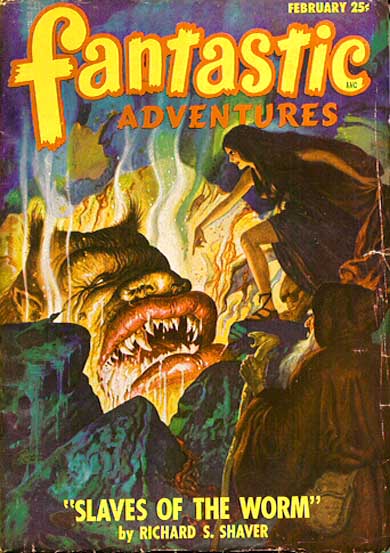
At some point in high school I began listening to Coast to Coast AM.  Now, I'm not a conspiracy theorists, and my primary reason for listening to the show is its unintentional hilarity.  However, I have drawn a great amount of inspiration from the litany of whack job guests for both Call of Cthulhu and D&D.  Just before I entered college they had a guest on who discussed Hollow Earth theory and the Shaver Mystery.  The combination of bat-shit-insanity, Ufology, lost races, and dinosaurs really tickled my brain.  I tried to work vast, subterranean areas into my Wilderlands games, and eventually I came up with my own Hollow Earth setting.

The Underworld is a cool setting.  I said in one of my responses to Zak's questionnaire that of all the things I've made I was most proud of Nightwick Abbey.  This is true; however, I have a feeling that if I was ever able to get Underworld to work that it would be my greatest creation.  Nightwick Abbey is obviously an idiosyncratic blend of things I enjoy, but those things aren't that far from baseline D&D.  Underworld is different while still fitting very well with the kinds of activities one does in D&D.  It has more or less been replaced by Uz,*** but I sometimes think Uz lacks the requisite amount of wonder.  It has plenty of terror though.

Lost world fiction had greatly affected the way I view D&D.  They define the range of emotions that I seek to evoke as a DM and that I want to feel as a player.  I want to marvel at things not seen before by human eyes.  I want to flee in terror from pallid creatures who have grown sightless in their benighted land.  I want adventure.

This post has become much longer than I originally expected.  I'll spend further posts discussing the different ways to do lost world scenarios in D&D and the pros and cons of each.  I don't know how many further parts there will be because I initially intended this to all be in one post.  If the other parts run away with me the same way this one did, you can expect a lot more.

*One of those few things was the Universal monster movies of the 30s and 40s, and I would later add Hammer to that list.  However, I've already made that setting.

**Notice I remembered several of the ones from Valley of the Dragons despite the fact that I do not have any way to watch the trailer.  Now that is good advertising.

***There may be some Uz related announcements shortly.  On a related note, make sure you're reading Dandy in the Underworld and Rogues and Reavers.  They're cool blogs run by cool people.