Normally I do these posts for something I haven't developed as much as I have Karse, which I've posted about a few times, but I want to nail down some of the bigger picture stuff and think about how I would actually run it.
The name, I should note, comes from taking Sark and Gygaxifying it. After hearing it said "Cars" by a number of blog readers I play online games with, I added the E to make it clear it rhymes with arse. Apparently there is a place in the Forgotten Realms called that, but I haven't thought of a better name yet.
Karse is made up of a set of islands - a largish main island shaped like southern Britain, smaller islands that are like a split off version of Wales and Cornwall, and an archipelago like the Heberdies stuck at the top.
The main island is home to a fair number of towns and one city - the capital of Nindle.
The area between these towns is sparsely populated moors and marsh or the occasional greenwood.
These between-spaces are the haunts of giants (leftovers from the first race to live on the islands), fairies and elves (the second race), the undead, and vicious bandits.
In a crater lake north of Nindle there sits an island. On that island are the ruins of Llamalot, the capital of Rutha the Unconquered who united the peoples of Karse long ago. This acts as a large dungeon/ruincrawl for those who like that sort of game.
Travel between towns is fraught even in the day time. Visibility is rough due to the almost ever present mist which is only occasionally banished by the Sun, whose glare then blinds the Karslish eye unused to its presence.
The most famous giant roams the remains of the road between Nindle and the ruins of Llamalot. His name is Headless Jack. Once he had two heads, but Brutus, the son (or maybe father?) of Rutha took off one of the heads and now he roams the countryside mourning the loss of it. If you hear his cries come from across the moors you'll get the shits.
The idea, in case it was not clear before now, is to create a kind of spooky/miserable setting based on British folklore, folk songs, Arthurian Myth, Celtic Mythology, and filtering that through the World of Nightwick as already established.
Other monsters include fomorians, linworms, nuckalavees, and any number of other British or Irish bugaboos.
Social class would play a big part in town - where the gulf between the nobles and the peasantry is vast - but very little part in the misty wastes between them.
Brian Froud and Alan Lee are major visual influences but you kinda have to imagine them with meth mouth. The over all effect, I hope, will be something like a mix of Excalibur, Jabberwocky, and Hammer Horror.
I'm not sure if I would use some version of D&D for this (either OSD&D or 5e) or some WFRP derivative, given the tone.
The Outlandish Knight (HD 6+1 AC 18 ST 12 Move 12, Only hit by +1 or better weapons or cold iron)can be found in a sea-cave in hex XXXX. He lairs there with his six drowned brides (HD 2, AC 16, ST 16, Move 12, Undead) who wish they were somewhere else. If encountered in the cave he will strike out madly with a +2 greatsword (+3 to damage due to his maddened state). If the cave is found at night, when he is out wandering, the brides will try to ambush and drown victims in nearby eddies.
There is a 1 in 6 chance that he will be in any nearby coastal village the players are visiting, courting a lady with his charm ability (may only be used on one victim at a time, lasts until dispelled). He will persuade these women to steal their parents' money and horses and come with him to the seaside, where he promises there is a boat waiting. There never is. Women so tricked are added to the drowned brides. For each drowned bride the Outlandish Knight has he gains 1 HD. While he has a charmed victim he gains +1 to his HP.
The Knight appears as a knight of the Northern Isles, but with finely polished silver armor with a ghastly visage. If his helmet is removed his misshapen elf-head is revealed and any charm effects currently active will be dispelled if the victim is able to see him. His brides appear as beautiful women with damp hair clad in wet gossamer. Striking them is like striking cold steel.
In his sea cave he has accumulated a small treasure hoard from his victims. Notably he has enough fine clothes to be worth 6,000sp, and 300gp in coins.*
*Note: The Nightwick campaign uses a silver standard.
A fool once said that magicians are "either diabolists or cowards" for even though he was a fool he knew the Power offered by the beings of the Pit outstrips that which can be learned from study alone. But what is the cost of the Power?
Dark Masters
The only true Way to Power is to submit oneself to the will of a Dark Master. While this means the loss of one's Will, many see it as superior to scrounging in the dirt for arcane secrets and being limited by the Laws of Reality.
Summoning
To make a pact with with a Dark Master, one must first summon it into the World. The rituals for this are usually and unfortunately very simple, but they only have a percentage chance of succeeding equal to the supplicant's Charisma + Level. After it has first been summoned, the caster may call the Dark Master again at double this percentage chance.
Summoning is a dangerous process. The supplicant must roll a d20 under their Wisdom score in order to have accurately prepared the protective wards necessary to survive contact with a Lord of the Pit. If they fail to do so they are either dragged to the Pit or hideously transformed, depending on the nature of the Master. For example, Armadeus takes men in a puff of greasy, sulfurous smoke while the Horned One turns them into mindless deer-men.
When making a pact, the supplicant must submit to the Service required by the Master. This is not to be done lightly, but once a Lord of The Pit is summoned they rarely leave without their pound of flesh.
In addition to making pacts, summoned demons may also teach spells. This requires a sacrifice the total HD of which must be equal to three times the level of the spell or a sinister task created by the referee with the campaign in mind.
Entering into a pact changes the character's alignment to Chaotic automatically, if it was not so already. Being taught a spell changes the character's alignment to the next alignment towards Chaotic, so Lawful characters become Good, Good characters become Neutral, etc.
Anti-clerics may not enter pacts as the Dark Masters are already the source of their Power.
Pacts
Here are the mechanics for the three most common pacts witches and sorcerers are likely to enter into in the Dark Country.
Armadeus
Armadeus is the master of secrets, shadow, and in some texts the Undead.
Service
The supplicant must write his Secret Name in Armadeus's Black Book in order to receive the Power. Once he has done so, he will automatically fail his saving throw against any effects caused by the demons in Armadeus's twenty and seven legions.
Level 1 (Prestidigitator)
The supplicant receives a familiar in the form of a black cat with piercing green eyes. Once per day, the familiar will reveal the location of a hidden thing to the supplicant.
The familiar spirit may also be dismissed to search for the Secret Name of any creature. This process takes one full day for Chaotic creatures, one week for Evil ones, one month for Neutral creatures, and one year for Good creatures. There is only a 50% chance of success with Neutral creatures and a 25% chance for Good creatures. The familiar will never learn the name of a Lawful creatures.
If the supplicant learns the Secret Name of a creature in this fashion, any saving throws made by the creature against effects caused by the supplicant are at a -4 penalty.
Level 6 (Magician)
The supplicant may retreat into his shadow once per day, becoming two dimensional and immune to non-magical weapons during this time. While in this form he cannot attack or manipulate three dimensional objects, but he only has a 2 in 6 chance of being noticed by those who did not see him transform. To exit this state, the supplicant must make a saving throw. On a success, they emerge from their shadow. If they fail, they must remain in their shadow for a full day. After three failures, the supplicant is stuck forever as a shadow and becomes an NPC with the statistics of the shadow described in the S&W Monsters booklet.
Level 11 (Wizard)
The supplicant may use their knowledge of a person's - but not a creature's - Secret Name to enthrall them. To do this, they must make eye contact with the person and the person must make a saving throw at the -4 penalty conferred by knowing their Secret Name. If they fail they are in the thrall of the supplicant until Dispel Chaos is cast on them. If the supplicant should die and the person is still enthralled, the victim will seek to resurrect the supplicant in any way possible.
The supplicant may have up to two thralls +/- their Charisma modifier.
Crapoad
Crapoad is the Father of Toads and Font of Blasphemies.
Service
The supplicant must accept a toad into his throat. This toad will exist parasitically off the supplicant, and thus the supplicant will require twice the amount of food and water normally needed by humans. If this diet is not met, the supplicant shall not gain any benefit from natural healing.
In addition to this increased need for food, any time a spell is cast by a Cleric in the sight of the supplicant, the toad will belch a hideous blasphemy that has a percentage chance of negating the spell equal to the supplicants Charisma score.
Level 1 (Prestidigitator)
The supplicant gains a toad as a familiar. This is not the same toad that lives in his throat. Once per day this toad will reveal the location of any text the supplicant can describe, including a spell scroll.
Level 6 (Magician)
Once per day the supplicant may see through the eyes of any toads within the five mile hex they currently are in. In doing so they automatically find any locations, persons, or creatures that are outside, assuming the weather is amenable to toads. While searching in this way, the supplicant's body is in a catatonic state. A saving throw is required to exit this state. After three failed saving throws the supplicant's mind is switched with that of a toad and he is sent to wander among the bog as his body hunts for worms and flies to eat.
Level 11 (Wizard)
The supplicant may "silence" a cleric by causing any utterance - including attempts to cast spells - to come out as some hideous blasphemy or heresy. This requires eye contact and the sign of the evil eye to be made at the cleric, at which point the victim gets a saving throw. The effect lasts until a successful save dispels it, with a new save allowed every sunrise or until Remove Curse or a similar spell can be cast.
The Horned One
The Horned One is the Master of Beasts and of the Lusts of Men and Women.
Service
The supplicant must submit to the Horned One's hideous advances, After the initial pact is made, all of the supplicants hit die are rerolled until a lower number is achieved. This becomes the new HP total for the supplicant until they gain a level. There is also a 30% chance the supplicant, regardless of gender, becomes impregnated with 1d3 devil-men as describe in the post on the Horned One.
The supplicant must renew the pact every year at a Black Sabbath held on Candlemass Eve. When this occurs the HD are again rerolled, though only once and the lower of the two HP totals is taken, meaning their may be no change. There is also, again, a 30% chance of becoming host to 1d3 devil-men.
Level 1 (Prestidigitator)
The supplicant gains a black goat as a familiar. This goat, at any time, may lead the supplicant to the nearest community of beast-men, devil-men, witches, or werewolves. This is easy as these often cohabitate. These beings will also know the supplicant as a friend.
The familiar also speaks the secret language of beasts, and once per day will translate for the supplicant. He will under no circumstances teach this language.
Level 6 (Magician)
Once per day, the supplicant may summon 2d6 hit die worth of beasts or beast-men - the type of which is determined by the refree and the number of which is determined by the hit die. These creatures attack anyone in the immediate area of the caster. The supplicant, and anyone aligned with him, must make a saving throw or be assaulted themselves. Good and Lawful characters always fail these saving throws. Once their quarry has been slain, they will return from whence they came.
Level 11 (Wizard)
The supplicant may, once per day, turn 2d6 hit die worth of persons into beasts or beast-men, caster's discretion. There is no limit to the HD affected, but a saving throw is allowed.
Marks
In addition to the other traits gained through pacts, each Dark Master makes its Mark on the supplicant. This becomes more pronounced as the supplicant levels. The individual marks are omitted from this post in order to prevent the Nightwick playgroup from metagaming.
In the days before Rutha the Conqueror, the pagan kings of Kars would kill their political enemies in ways that humiliated the victim and placated the strange gods of the fens. Unfortunately for the people of Kars, these “gods” were actually demons who managed to shake off their chains and gain purchase on the mortal realm. These beings use bog mummies as horrid servitors, and have granted them the ability to make more of their kind.
Bog mummies appear as withered corpses with blackish, leathery skin and slashed or strangled throats. They are often completely nude with their eyes, nipples, and tongues removed. These acts were considered degrading by the pagan Karslishmen, but they impede the bog mummy in no obvious way.
Bog mummies are extremely adept at sneaking up on opponents in the fen-pool tombs. As such, they possess a 3 in 6 chance of surprising their opponent. Bog mummies typically possess the weapons used to end their lives - typically a strangling cord or dagger. Those with garottes tend to surprise their opponents from behind and throttle them, dealing automatic damage each round after the initial to hit roll.
These horrid creatures create more of their own kind from the corpses of their victims. Travellers passing through the marshes speak of seeing ghastly gatherings of these creatures dancing on their victims, pushing them deeper into the mud. These corpses rise as bog mummies at the rise of the next moon.
Mooncows are mooncalfs that have been enlarged by necromantic or diabolic energies - either from a diabolist or from an evil place. They appear as cow-sized creatures made of horribly pale, hairless flesh. Their eyes are either white and rudimentary or completely undeveloped, and their hooves are fleshy and underformed. Strangely, their teeth and horns are always full developed, if strangely colored. Their low is a sickening, almost human sound that reminds the hearer of a dying babe.
Viewing a mooncow is hazardous for the mind. When a human or demihuman character sees a mooncow, they must make a saving throw or roll on the following table.
The character is gripped by a strange, religious mania and must bow down and worship the cow(s).
The character is possessed by a strange, homicidal frenzy and must attack the nearest human/demihuman.
The character enters a crying (1-3) or laughing (4-6) fit in which they can take no other action.
The character collapses onto the ground with strange visions of the Demon Moon swirling in his/her head.
This saving throw is made each round, but once a successful save is made no further saves are required.
It is said that on the Demon Moon that drifts through the spheres well above the World of Nightwick that Mooncows are hearded by strange, pallid men who do so in the service of beings best left unmentioned. Where they get the mooncalfs is a mystery even to the West's most learned alchemists and scholars. Mooncows are usually created in the World because their milk is a fairly common ingredient in potions, poisons, and ritual magic.
It is said that the moon also has Moonbulls, which are as mooncows with maximum HP and incur a -2 penalty to the Save vs. Magic.
The head of Karslish nobility is, obviously, the King. Centuries ago, the isles of Kars were home to hundreds of tiny chiefdoms. Each worshiped its own patron god, and a almost constant state of war existed between them. That was before the coming of Rutha the Unconquered, an Averois noble who conquered the largest isle with an army of Averois knights and priests of law. He used the religion of Law to unite the chiefdoms, and ever since Kars has been ruled by an Averois house.
King Dwarde II Walks Among his People
The current king, Dwarde II - also known as Dwarde the Hideous - is an especially deformed member of a long line of misshapen hunchbacks. It is generally agreed that he is the most incompetent king in the history of the isles, worse even than Ethelray the Bungler. Peasant revolts have been common during his reign, and the nobility have taken to slaughtering each other as the lack of central authority has caused old grudges - some stretching all the way back to the chiefdoms - to resurface.
Within his palace, Dwarde the Hideous attempts to maintain an heir of omnipotence. He has resurrected an old pagan custom that horrifies even the most sycophantic of his courtiers: all who wish to pay homage to the king must suckle his nipples. He particularly enjoys making nobles wait in line for this "honor."
Oddly, there currently exists no plan to usurp the throne. Dwarde's incompetence has given the nobles free reign to pursue their vendettas, and a new king would only be more competent. Because of this, the nobles of Kars have allowed themselves to be humiliated in the kings court in Nindol, knowing that they are the ones who hold true power in the kingdom.
A Joust at the Great Nindol Tourney
During the few hours in which Karslish nobles are not killing each other, they spend their time coming up with increasingly bizarre amusements. The diversion with which they are most enamored is, unsurprisingly enough, the tourney. The most famous tourneys are those held in Averoigne; however, the popularity of tourneys on the Karslish Isles rivals or perhaps even surpasses that of the continent.
The greatest tourney in the land is the annual one held at the end of Spring in Nindol. On this one day, Kaslish nobles eschew their personal heraldry and all don finery of the deepest red. This is because the Nindol joust is done to the death, and it is not uncommon for blood to spray out onto the crowd. In order to avoid the complete decimation of the chivalry of Kars, the Great Tourney of Nindol is actually a series of independent jousts. Each knight will only compete in one event, but the purses for these are incredibly large.
n recent years, a few young knights have begun to buck tradition and wear white during their jousts. If they live, they will wear their blood soaked garments to many a social occasions so that they may tell stories of their victory. This is considered gauche by most knights, but it is the ladies these jousters seek to impress.
The Burning of the Imbeciles
Another annual event that delights the nobility is the Feast of St. Ralph the Liar. His feast day is of course celebrated in all lands that have seen the Light of Law, but no other kingdom enjoys it so thoroughly. Since the time of Rutha IV - known as Rutha the Impotent - the feast has been ended with an event known as the Burning of the Imbeciles. Village idiots are rounded up from all around Kars and brought to various courts preparing for the feast. They are then dressed as various exotics - cynocephali has been the most popular in recent years - and allowed to dance around the dining hall. When the dinner is just about to end, the idiots are corralled into the center of the room and lit aflame, much to the delight of all present.*
The other men of the West view the Burning of the Imbeciles as an act of barbarism. An Averois scholar studying the phenomenon concluded that it must have begun with a terrible accident and then have continued due to the mixture of amusement and superstition that surrounds it. Karslish nobles believe that if the imbeciles are not burned for the feast, a bevy of unlucky things might transpire. One year, the king decided to forgo the burning and skip straight to the after-diner cake. He found it to be so dry that he gave it to his dogs, and ever since the imbeciles have been burnt at the proper time.
The High Pontiff has forbade both tourneys and the Burning of the Imbeciles, believing both are pagan rituals in disguise. This has had little effect on the religious climate of Kars, as both the Archbishop of Tenkerbury and the priests of Bury St. Ralphs fully support these events. It is perhaps no accident that they also make quite a bit of money off of them.
The Northern Isles are home to a different sort of noble. While some of the younger generation attempt to imitate the courtiers of Nindol, most cleave to their old way of life. They are nominally loyal to both the king and to the God of Law, but little has changed since the days before Rutha the Unconquered. Warriors raid each other's cattle, and village priests perform rites once reserved for pagan druids.
A Pit Fight on One of the Northern Isles
In the North, both nobles and peasants alike enjoy watching pit-fighting. These fights to the death are believed to be the origin for the Grand Tourney of Nindol; however, they never take the form of jousts. Instead two men fight in a muddy pit, either with hand weapons or their bare fists. In either case, the winner is the one that walks away.
Competitors are typically captives from nearby settlements who have chosen this over more conventional forms of slavery. On rare occasions, nobles or even chieftains will deign to fight, though they usually only do so if their opponent is also a noble. This is sometimes used as a way to settle disputes, though it is comparatively rare.
Jabberwock No. Encountered: 1 (1) Alignment: Chaotic Movement: 90’ Armor Class: 3 Hit Dice: 10 Attacks: 4 (Bite/Stomp/Stomp/Tail) Damage: 1d10/1d6/1d6/1d4 Save: F10 Morale: 8 Hoard Class: XV but see below XP: 3,100
The Jabberwock, or perhaps Jabberwocks though only the most pessimistic of men would entertain that idea, is a hideous monstrosity native to the isles of Kars. It is known to attack travellers along the road near the Tulgey Wood, setting upon them from seemingly out of nowhere. Rumor has it that the great beast hordes treasure, not unlike a dragon; however, its lair has never been found.
The Jabberwock appears as a large, clumsy, wyvern-like creature with tattered, useless wings, a long neck, and a misshapen, bulbous head. Accounts of its color vary - leading terrifying credence to the idea that there may be more than one - but it is the general consensus that it is either a mottled grey or a musty yellow.
The Jabberwock is only hit by +1 or better weapons. It is surprisingly stealthy and has a 3 in 6 chance of surprising opponents. The Jabberwock is incredibly stupid and speaks no known language, instead it burbles out a hideous noise that causes a morale check in any NPCs encountering it.
Precis: Petty, pseudo-British lords fighting over shitty islands. Terry Gilliam's Westeros.
Conspectus: The Mad King of the High Tower - a hunchback with a malformed face - leading ill planned raids onto the continent; horrid bogs filled with nuckelavee; strange women lying in ponds distributing swords; Jabberwocks and other weird, wormy dragons; petty nobles fighting for who will be the next king once the current one is assassinated; Orknies carrying off children in the night; ancient stone circles with strange and terrible powers; haunted barrows of pagan kings; bands of outlaws stealing from the rich and giving to themselves; fanatical holy men chaining themselves to boats and casting themselves out to sea; crumbling, haunted manor houses; foul miasmas spreading plague; deadly tourneys that are little more than an excuse for murder; rustic northern lords who prefer raiding for cattle to dealing with the politics of the South; wise women who know how to heal and harm with ancient magics; long, winding roads harried by strange giants; foreign cronies who have brought devil worship into lordly courts; terrifying sea raids conducted by beastmen on unsuspecting villages.
Taste, Sound, Image: a Cornish pasty and dark, warm beer; The Sea Nymph's "Dergo"; Terry Gilliam's Jabberwocky
Orknies are creatures most commonly encountered in the stories told in the courts, taverns, and brothels of Kars. These tales most commonly concern unlucky women who marry a rich noble from the Northern Isles only to find out he's a blubbery, murderous thing whose castle is under the sea. This is what counts in Kars as satire.
Fishermen in the Northern Isles know better. Tales of Orknies, or as they call them the Sea Things, in those regions take a far darker turn. It is said that the fiends waddle up to seaside houses at night and peer in through the windows. Many say they've heard them muttering in some incoherent language which sounded both soothing and frightening. Whenever a child or young maiden goes missing, Orknies are almost always blamed. Some of the more disreputable and mad sailors claim they've sen a vast, underwater city in which the Orknies play with drowned children, but who can believe those drunkards.
To avoid being taken, coastal villages will often leave animal sacrifices on the beach in the hopes that those carcasses will satiate whatever dark pleasures the Orknies wish to indulge. The Church has placed a ban on such action, believing that it is a Pagan rite whose days are long past. Surely the God of Law would protect the innocent from molestation, say the priests. The peasants are less convinced.
Those few who know of Orknies in the Dark Country primarily know them as a heraldic device. Noblemen from the Northern Isles often ironically adopt them as their colors, a habit the majority of the West finds quaint at best and that the peasantry of Kars finds sickening.
Orknies No. Appearing: 1 (3d6) Armour Class: 14 Hit Dice: 2+2 Move: 60'/120' (swim) Attacks: 2 (flipper 1d4 and see below), or Gaze (see below) Morale: 6 Alignment: Neutral
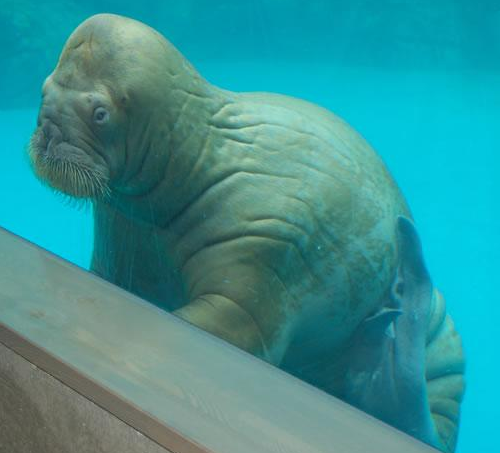
Orknies are bloated, blubbery monstrosities possessing a vaguely humanoid shape and terrifying appetites. They stand roughly half a head taller than a man, and their gate is a gross, undulating waddle. Some scholars claim they are sexless, but others claim that the presence of something resembling facial hair on some points to a difference between male and female creatures.
Despite their generally clumsiness on land, Orknies can be eerily silent when they want to be. At night or in other dark places they gain surprise on a 1-3 on 1d6. They are found of dragging off victims -- usually young children or beautiful maidens. Their beady, imbecilic eyes posses a strange power, and any human or demihuman 1 or less hit die must save vs. paralysis or be unable to move or speak for 3d6 rounds. The Orkney may make two attacks with its flippers. If both hits are successful, the target is grabbed and silenced (since Orknies always make sure to wrap one of their flippers around the victim's mouth). Before entering the water they employ an air-tight bag made of an unwholesome, leathery material that both muffles the victim and provides he or she with what scholars believe to be an endless amount of breathable air. These devices, when captured, do not seem to work in the hands of non-Orknies.
Orknies are cowardly beasts, and will usually flee at the first sign of armed resistance; however, if they have any victims grabbed they will not release them unless slain. What they do with the poor women and children they take to the depths is best left to the imagination, for the reality is far too terrible for this blog post to relate.
EDIT: It has come to my attention that I have neglected their unnerving habit of tapping on windows during stormy nights. There. Now you know they do that.