Showing posts with label monsters. Show all posts

Friday, August 12, 2022

Scitalis


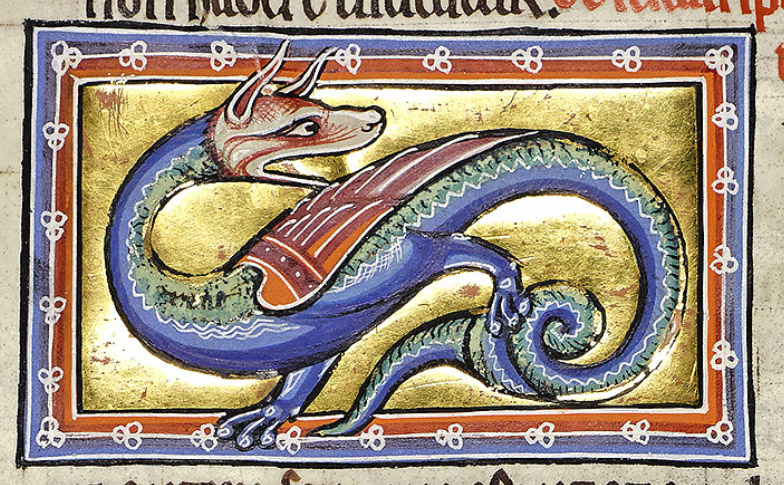
A scitalis is a strange form of serpent found only on Cuccagna and its outlying islands. Whether it is the creation of some mad wizard - perhaps Prospero himself - or a relatively natural creature of the World of Nightwick is unknown to scholars. Some scant few believe that it is the descendent of normal serpents who have been warped for centuries by the weird magics of Cuccagna, though most agree that the magicians who inhabit the island have not done so for so long.

It appears as a serpent with a pair of vestigial wings and two stunted limbs, neither of which aid it in locomotion. Its head is rather like that of a normal serpent, but it sports two protrusions that look rather like the clipped ears of a fighting dog. In life its scales are pulsing and scintillating, forever creating new patterns across its opalescent hide. In death they maintain their iridescence but lose all sense of motion. 

Scholars of Cuccagna say that the mesmeric effect of the scales is created by a combination of their strange alchemical makeup and the creature's extreme body heat. The source of this heat, whether organ or stone swallowed in youth, has yet to be found.

AC 15 (4), HD 3, Attk 1 Bite (1d4 + Constrict), THAC0 16 [+3], MV 90' (30'), SV D10 W11 P12 B13 S14 (3) AL Neutral XP 30 NA 1 (1d6), TT U

  • Brilliance: Anyone looking at the scitalis must save vs spells or become hypnotized until they can no longer see the scitalis (including if it dies) or until the victim is constricted. Victims stand still, simply gazing at the scitalis. 
  • Averting Eyes: -4 penalty to hit. The scitalis gets a +2 bonus to attack.
  • Constrict: 2d6 Automatic damage each successive round after a successful bite attack.
  • Body Heat: If either damage die for Constrict rolls a 6, the victim must make a save vs breath or lose all flammable items.

Thursday, June 15, 2017

Dinosaurs of Yavana

Castles & Crusades doesn't have a lot of dinosaurs so here are the ones that inhabit Yavana converted from AD&D.  I tried to have it so that certain types (club tail, long neck, duckbill) only had one representative so that I didn't have to describe minute differences between extinct animals.


Allosaurus #1d2 AC 14 HD 15 Move 120’ Attacks 3 (1d4, 1d4, 6d4) Save P  Vicious predator, can run across the ground at great speed.

Ankylosaurus #1d4+1 AC 19 HD 9 Move 30’ Attacks 1 (3d6) Save P Armadillo-like dinosaur with club tails and armored plating.  If attacked or threatened uses tail as club, otherwise docile.

Camarasaurus #2d4 AC 13 HD 20 Move 15’ Attacks 1 (3d4) Save P Swamp-dwelling Smallish (50’ long) long-necked dinosaurs.  Easily spooked.  Attack represents trample.

Compies #3d6 AC 14 HD 1 (1d4) Move 30’ Attacks 1 (1d3) Save P Small, carnivorous dinosaurs.  Hunt in groups.  10% chance a group will confer a disease as giant rat.

Dimetrodon #1d2 AC 15 HD 3-5  Move 30’ Attacks 1 (1d10+5) Save P  Sail-backed reptile ancestor of mammals.  You know the one.

Dinichthys #1d4 AC 13 HD 10 Move 60’ (swim) Attacks 1 (5d4) Save P Actually giant mean fish, not dinosaurs.

Elasmosaurus #1d2 AC 12 HD 15 Move 60’ (Swim) Attacks 1 (4d6) Save P  Long necked reptiles of the loch-ness type.

Mosasaurus #1d3 AC 12 HD 12 Move 10’/60’ (swim) Attacks 1 (4d8) Save P Crocodile-like marine dinosaur that goes on little flippers.

Orintholestes #2d6 AC 15 HD 2 Move 60’ Attacks 1 (2d4) Save P Man-sized predators that run incredibly fast.  Feast on men and on dinosaur eggs.

Plateosaurus #5d4 AC 14 HD 8 Move 30’ Attacks 1 (2d4) Save P These are panicky herbivores that go on two legs.  Attack represents trampling.

Plesiosaur #1d3 AC 12 HD 20 Move 60’ (swim) Attacks 1 (5d4) Save P  large (50’ long) marine loch-ness type.

Pterosaur, Giant #1d8 AC 14 HD 6 (d10) Move 10’/60’ (fly) Attacks 1 (3d4) Save P  Giant flying lizard that can carry off a large horse.

Raptor #1d6 AC 15 HD 4 (d10) Move 60’ + 5’ Jump Attacks 3 (1d2/1d2/2d4) or 1 (2d6) after jump Save P Technically deinonychus, but everybody calls them raptors.  Have bright feathers.

Trachodon #2d6 AC 14 HD 12 Move 60’ Attacks 1 (1d8) Save P  Duck-billed dinosaurs of the plant eating sort.  Run from attack; only defense is lashing tail.

Friday, April 22, 2011

An Orc is an Orc of Course of Course...


The players in my Nightwick Abbey game recently discovered (i.e. last session) that Orcs in the Dark Country have no genitals.  Since Ffraid was technically a character in my short lived Keep on the Borderlands game, she was able to inform them of the horrible manner in which Orcs reproduce.  

One of my players asked how the hell you have Half Orcs then, but of course there are no Half Orcs in the Dark Country.  He seemed fine with that answer, but his question got me thinking: have I changed some of these monsters too much?

Why the hell do I still call the bestial things which breed with witches' spells and magic pools Orcs?  What is the point?  Of course this is a slippery slope since at some point you start to say "well why am I using D&D since I've made all new monsters?" and that way madness (or T&T) lies.

I'm not really sure what to do about all this yet.  It mainly shows up in the way that I have to avoid all the Gygaxian naturalist sections of the MM because I have my own explanations for those sorts of things -- though Goblins and Hobgoblins mate in the usual manner.  I will say that what little tension there is between my gaming group and the setting -- and it is very little tension -- comes from how bizarre the setting can be.  If I had to do it over again I'd probably go with a more "beer and pretzels" set up, but I didn't do that and Nightwick Abbey has been loads of fun so far.