Monday, April 2, 2012

Jeff's Twenty Campaign Questions for Nightwick

1.  What is the deal with my cleric's religion?
Clerics in the World of Nightwick universally worship the God of Law, as it is the only true god in the setting and therefore the only entity that can provide clerical powers.  The Church of Law has at least two branches (Universal and Zenopolitan Orthodox) which resemble an overly fascist version of the Latin Church and an overly permissive and somewhat sinister version of the Eastern Orthodox Church.


The other religions that exist are primarily focused around the worship of the Old Gods, extremely powerful entities who must be placated in order to prevent a number of natural disasters.  The Church estimates that the vast majority of unwashed humanity living in the World of Nightwick are at the very least secretly pagan.  Those special few who know the proper rituals to placate the Old Gods are typically Druids.


Diabolists and demoniacs also practice their foul religion in the Dark Country (and, though no one would like to admit it, beyond).  Their "priests" are typically magic users though anticlerics are not completely unheard of.  Their trappings are typical Satanist paraphernalia.


2. Where can I buy standard equipment?
Rupert van Toad, the local Frogling merchant of the van Toad house runs a small shop just outside the village walls that provides a variety of common, and sometimes uncommon, goods.  However, he is subject to the whims of his corporate masters.  A more reliable source of goods is the market in Lychgate, but the road is long and perilous.


3. Where can we go to get platemail (sic) custom fitted for this monster I just befriended?
While that situation is unlikely, the local village blacksmith -- a young man named Duncan -- is said to be a sort of idiot-savant where smithing is concerned.  


4. Who is the mightiest wizard in the land? 
The locals insist that it is Halfdan the Black who resides in the crumbled tower just south west of the village; however, their knowledge of the whole land is suspect.


5. Who is the greatest warrior in the land? 
The general consensus is Arnawald the Black Eagle is probably the most powerful and cunning warrior.  It is said he has designs to take unite the Seven Cities into one kingdom.


6. Who is the richest person in the land?
Notker the Unshaven, the Bishop of Lychgate, is a likely candidate; however, the patriarch of the van Toad family is pretty damn close.


7. Where can we go to get some magical healing?
The vicar of Nightwick Village probably has you covered.  Even the two Silent Brothers who assist him seem to be able to work petty healing miracles.


8. Where can we go to get cures for the following conditions: poison, disease, curse, level drain, lycanthropy, polymorph, alignment change, death, undeath?
For the more advanced stuff you'd have to talk to Notker the Unshaven, but by all accounts he is an asshole.   Level drain can be cured by killing the creature who inflicted it within 24 hours of the attack.  Otherwise it is permanent.  


The conditions beyond the bishop's powers might be curable by the various court wizards found in the Seven Cities, but who trusts those guys?


9. Is there a magic guild my MU belongs to or that I can join in order to get more spells?
Nope.  Magic users are too cowardly and suspicious to trust one another; however, individual magic users of high level have been known to take on apprentices.  They usually ask for hideous favors though.

10. Where can I find an alchemist, sage, or expert NPC?
Amalric the Incontinent is the known to be wise in the ways of past things.  He resides in Lychgate.  Other sages abound and usually make their homes in either the Seven Cities or near pagan shrines, depending on their religious affiliation.

Halfdan the Black is said to be able to brew a potion or two.

11. Where can I hire mercenaries?
Nightwick village has been more or less taken over by Badder's Boys, a nefarious mercenary company that spends most of its time fulfilling the bishop's wishes for petty revenge.  Many of the young lads who serve in the company have a rather liquid sense of loyalty, and the sight of a few coins will convince them to find new masters.  How happy or unhappy this would make Lord Eckhard, the governor of the village, has yet to be seen.

Other mercenaries might be hired at any of the Seven Cities, and there is a constant trickle of fighting men from the West.

12. Is there any place on the map where swords are illegal, magic is outlawed, or any other notable hassles from Johnny Law?
The bishop of Lychgate is a dick who has an incalculable number of pet peeves he has labeled as capital offenses.  Practicing magic or openly being pagan is highly illegal in most of the Seven Cities and will get you tied to a stake and lit on fire.  Practicing clerical magic or open worship of the God of Law will get you hanged in most pagan settlements.  Tread lightly.

13.  Where is the nearest tavern?
Right in the center of the village.  It's the Medusa's Head and is owned and operated by Bruno the Bloated Barkeep.  It is a frequent haunt of Badder's Boys.  The woodsmen who made up the bulk of the village's male population before the arrival of the mercenary company typically drink in their lodge, but strangers are not allowed in.

14. What monsters are terrorizing the countryside sufficiently that if I kill them I will become famous?
The most obvious answer is the White Lady, whom some believe is actual one of the Old Gods.  Her foul, half-bestial servants have been raiding caravans along the Long Road and it's starting to become a serious problem.  There is also a dragon rumored to live in the Bald Mountains, a whole village of werewolves, and who knows how many devils lurk about.

15. Are there any wars brewing I could go fight?
The Dark Country is pretty much in a constant state of crusade.  I'm sure any of the Seven Cities would be glad to enlist you to fight the vile pagans and vice versa.  Arnawald's ambitions for uniting the cities will also undoubtedly cause their fair share of bloodshed.  The men of the West are not squeamish about spilling each others' blood.

16. Are there any gladiatorial arenas complete with hard-won glory and fabulous cash prizes?
Not as such, no; however, whenever a noble from the West is visiting on crusade the Seven Cities like to wine him and dine him with great tourneys and melees.  These usually come with the associated glory and prizes with a much lower probability of death.

17. Are there any secret societies with sinister agendas I could join/fight?

18.  What is there to eat around here?
The pagans prefer dishes such as robber's steak (a kebab of beef or goat meat with bacon and red peppers), while the Westerners prefer to put everything in a pot and boil it until it's grey and tasteless.

19. Any legendary lost treasures I could be looking for?
The Sword Brothers supposedly brought vast amounts of treasure with them from the Desert Lands.  It's rumored to be somewhere deep within the abbey.  Several villages also have rumors of old Imperial treasures in the ruined hill forts and stone rings that dot the landscape.

20. Where is the nearest dragon or monster with Type H treasure?
In a long-abandoned Dwarf Hold in the Bald Mountains.  The Mountain King would pay handsomely for its head.


Wednesday, March 28, 2012

Crusading in the Dark Country

The Sword Brothers were originally founded to battle the foes of Law in the Desert Lands.  They, along with countless other holy orders and a number of laymen who wished to atone for their sins poured into that distant land, only to be ultimately sent back when resistance became too fierce.  The Men of the West blamed the decadent citizens of Zenopolis who, despite theoretically worshiping the God of Law were too enraptured with their strange drugs and sinister rites to lend troops.  Indeed, Westerners claim that the Emperor did all in his power to hinder these crusaders, a sure sign of his allegiance to the Pit.  Of course, those men of Zenopolis have a very different version of events, but that is beyond the scope of this entry.

After the failure of the crusades into the Desert Lands, the Sword Brothers turned their blades closer to home.  The Dark Country was once part of the Empire before it was smashed by the barbarian onslaught.  They decided it should return to the Law.  They set out to convert the population, by force if necessary.  This tale is a sad one and it is well known to those who know of the Dark country.

The cities they founded remained even after the great crusade that annihilated the Brothers, and they still wished to bring the Light of the Law to that benighted country.  Indeed, thousands of pagans still hide in the dark forests and high mountains, and they seek to return their land to Darkness.  There is also the threat of the heretics in Novgova and Muscgorod whose armies skulk along the foot hills of the Nameless Mountains waiting for the moment when they might strike and do devils' work.  One should not forget the threat of the nomads who lie in the great steppe just north of the Blood Red Sea.  While it is rare for these bloodthirsty raiders to cross the mountains, it is not unheard of.

Perhaps now more than ever it is important that the Seven Cities be bolstered by a stream of soldiers and settlers from the West.  Sadly, this stream has become a mere trickle after the destruction of the Sword Brothers and a number of infamous losses to the pagan warlords.  As such, the Seven Cities have attempted to make the idea of crusade more appealing to their Western neighbors.  For the past few decades they have tried to turn crusading into the equivalent of a winter holiday for Western Lords.*  Lords bring their troops from the West are treated to a tour of the Seven Cities, with a grand tournament being held in each with both jousts and melees.  Feasts are held each night, both in the cities and in the field.  The climax of all this is usually the token burning of a village, sometimes not even a pagan one.

All this is done in hopes of convincing the lord to move in permanently; however, it is difficult to hide the land's haunted nature.  Visitors who return to the West often comment on the level of brutality used even in the mock wars held by the Cities.  The inhabitants of the Seven Cities rarely show quarter to enemies, be they pagan or not.  Bodies are hung from city walls, men and women are burned alive in the streets, and children are roasted on spits.

And this is only the human terrors.  There has never been a more haunted land than the Dark Country, and the horrors found in its more remote reaches are things brave men shudder to mention.  They are things that prey on both the body and the soul.  Ultimately few who go on such crusades come back unaffected.  Only those who are most unhinged take up residency in the Seven Cities, and their savagery and fanaticism is infamous.

*Fall and winter are the usual seasons for military campaigns in the Dark Country because the cold temperatures freeze the fetid swamps so that armies might be moved across them.

Tuesday, March 27, 2012

Population Density, Demographics, and the Dark Country

I have a really hard time placing villages and towns in my campaign settings, anyone whose read this blog with any sort of regularity will have probably picked up on that by now.  What it essentially boils down to is that whenever I look at a map I've made I have no idea how many villages feels "right."  My eyes just sort of glaze over and I don't get any settlements.  I have long searched for some sort of process that will spit out a number of villages that I could place on a map.

This problem has caused me to post a number of times about demographics.  Whenever I do so, someone inevitably suggests Medieval Demographics Made Easy or one of the many tools designed to make calculations based on that article.  It's very easy to see why.  First of all, if the same people who are concerned with demographics are usually concerned with a sort of bean counting realism that I find strangely attractive but could never wholly embrace.  More importantly, it does exactly what I want it to.  It spits out a number of villages that should be in a given area.

But there are a few problems.  The primary reason I had previously been uncomfortable with these tools is that they generate a massive amount of villages.  An area the size of a Wilderlands map -- like the Dark Country -- would have thousands of villages even on their lowest population density levels.  I want villages I can name and plop near a dark forest so they can be menaced by werewolves, not an endless blanket of them.

This used to be my only problem with the system.  I decided it was simply too "realistic" and that I was better off looking for solutions elsewhere.  However, in doing a bit of "research"* I found some scant information of the population of Tranysylvania in the 15th century.  Now that is a bit later than my assumed time period, which is somewhere around the late 14th century, but it seemed like a good place to start.

It was then that I discovered another problem with the Medieval Demographics Made Easy system.  When I plugged in the area of Transylvania (roughly 77,000 square miles) it told me that at the lowest population density it would have about 1.5 million people.  It turns out that the figures I found for Transylvania said it only contained about 500,000 individuals.  That's a margin of error of one million people.

As regular readers will remember, the Dark Country is loosely based on medieval Transylvania (mixed heavily with the Northern Crusades).  So it would seem that the Medieval Demographics system doesn't account for the realities for that part of the medieval world.**

What I'm currently thinking of doing is figuring out about how many people would live in the Dark Country based on the populations of Transylvania, Wallachia, and Moldavia.  Then I'll divide up the population among the cites and try to make enough farms for them to reasonably eat and raise armies and stuff.  I'll also need to leave some room for the lingering pagan tribes so that they can be a realistic military threat to the Seven Cities.***

If I've messed up somewhere in my calculations, please let me know.

*looking on wikipedia -- so grain of salt yadda yadda

**I will assume it represents the populations of England fairly well without actually checking.  Those more concerned with that area can do so if they're interested.

***Post on pagan/settler warfare coming shortly

Monday, March 19, 2012

Monster Monday: Boggy-Man

Boggy-Man
No. Appearing: 1 (1d6)
Armor Class: 14
Hit Dice: 3
Move: 120'/240' (swim)
Attacks: 2 (claw 1d4) or 1 (grab)
Morale: 5
Alignment: Neutral

Boggy-men are loathsome creatures that make their lairs in marshes, swamps, and bogs.  They appear as emaciated humanoids with shockingly funeral features, despite the fact that they are not undead.  Their skin is sickly green and rubbery.  Their eyes are glimmering marsh lights.  Their mouths are foul holes, toothless and suckered.  Scholars, who are the only ones who concern themselves with such things, believe boggy-men to be one of the many hideous types of fairykind.

Boggy-men await their prey in muddy streams and other murky waters.  When a hapless victim strolls near, they lurch out and attempt to grab them.  The bogg-man makes a to hit roll and if successful the creature is grabbed and can take no actions other than attempting to break free.  The boggy-man will then plunge its victim into the water, and thereafter the poor sap will take automatic damage each round (1d6) as his or her lungs quickly fill with water.  Humans and demihumans thus slain become boggy-men within 1d6 hours.

An extremely cowardly and craven race, boggy-men will usually try to avoid fair fights.  Once they have an opponent grabbed, they will try to take him or her out of the reach of any companions who might be able come to the rescue.  If the creature finds itself cornered and isn't currently engaged in drowning a victim, it will fight with its claws or attempt to flee to its lair.  Boggy-men typically lair in rotten trees or mucky holes far away from the more frequently traveled areas of the swamps they haunt.  Here they may be accompanied by their wicked progeny.  They will also have an amount of treasure taken from unfortunate passersby, for they live all things that glitter and shine.

Tuesday, March 13, 2012

Greyhawk Maps

Here are some old maps I made back when I was running my version of Greyhawk.  As with so much I do, these use the Welsh Piper's map templates.


The one above was the map we were going to use to divide up the setting.


This one was my section (Greyhawk and its environs).

Monday, March 12, 2012

Organizations in the Dark Country

The Dark Country is a land embattled with itself.  Even in the face of numerous, inhuman threats that stalk the dark woods and wander in the high mountains, the Seven Cities constantly scheme against each other and wage terrible wars against the scattered remnants of the Hundred Kingdoms.   Men like Arnawald the Black Eagle and Notker the Unshaven wish to unite the Dark Country into a single kingdom, but it would seem that human avarice will dash their desires against the rocks.

And yet, the strife does not end here.  Holy orders, mercenary companies, criminal rackets, mystic cabals, and resistance movements compete with one another for resources and for rights in the Seven Cities.  These are usually not tied to a single city and will often play both sides of the more overtly political conflicts in an attempt to improve their own place in this fog-shrouded land.

There are far too many of these organizations for a single post, and I generally want to take a “make it up as I go” approach to worldbuilding.  As such, the organizations listed below represent only those that intersected with or were created by player action in the initial Dark Country campaign.  In the even that I’m able to get another campaign going with a semi-regular roster of players,* this list will hopefully be greatly expanded.  At some point I would like to assign mechanical benefits to joining each of these factions, but I imagine that is best done on a case-by-case basis.

The Sword Brothers (defunct)
Symbol: red cross over a sword pointing upwards on a white field
While not currently active, no discussion of the various factions of the Dark Country would be complete without at least a mention of the ignominious Sword Brothers.  Originally founded to protect pilgrims and merchants on their way to the Desert Lands, this Holy Order included a large number of Clerics,** Fighting Men, and even some Magicians.  At some point, the Brothers became interested in bringing the Rule of Law to the people of the Dark Country, and thus they began the first of many holy wars the region would see over the next few centuries.  At some point they fell into darkness and began worshiping a mysterious, diabolic entity whose exact nature is unknown.  Another crusade wiped them from the face of the Dark Country, but their scars still remain.

The Brotherhood
Symbol: a skull with a coin in each eye on a black field
The Brotherhood (of Thieves and Assassins) is a nefarious organization of smugglers, lowlifes, and thugs that has somehow achieved an air of mystery and mysticism.  To outsiders they are not unlike the mafia of the roaring 20s, possessing their own twisted code of ethics and being primarily concerned with the smuggling of goods and the flesh trade; however, rumors persist that they in reality a cult dedicated to a long forgotten Old God or a diabolic parody of a more venerable saint, depending on the teller.  By rights the Brotherhood should have been extinguished long ago in the fires of inquisition, but their usefulness to men possessing more legitimate modes of power has made them a permanent fixture in the Dark Country.

Bader’s Boys    
Symbol: a badger ringed with gold on a red field -- often coupled with the cross of Lychegate 
This mercenary company can be found in small numbers throughout the Dark Country, but they are by far the strongest in the city of Lychegate.  Their founder, the eponymous Bader the Badger, currently serves Bishop Notker the Unshaven of Lychegate as a military advisor – much to the chagrin of Lord Eckhard, governor of Nightwick.  They are infamous for their brutality and for their loyalty to the Bishop.  Their recent founding means that they did not fight in any of the famous battles in the history of the Dark Country, but they have proved to be excellent at the more monotonous daily oppression of the pagan population in the south east.

The Pagan Liberation Front (PLF)
Symbol: an elk's head
The Pagan Liberation Front was originally founded within the Bishopric of Lychegate.  It's mysterious leader, Yim Yimsley, has become a folk hero among the pagans living in that region, and his exploits form the basis of many tales.  Notker the Unshaven is convinced that he and his band are a cult of devil worshipers bent on the destruction of the cosmos.  He has offered an extremely high prices for Yim's head.  The PLF operates as a number of separate cells, many of which predate the actual formation of the PLF.  In a way, the PLF is not one organization, but a network of smaller groups dedicated to the removal of Western influence from the Dark Country.  There are rumors that this organization has ties with the Brotherhood.

The Order of the Elk
Symbol: an elk's head
The Order of the Elk is a military order founded to defend the weak from the forces of darkness.  Its founder, Paladin Lord Fitzgerald, is a controversial figure within the Church.  He and those of his order advocate for a peaceful method of converting the Dark Country.  The Church of Law should lead by example, Fitzgerald and his ilk argue.  If they hold back the tide of darkness, then even the pagans will flock to the Law.  Many are skeptical of these ideas, and the fact that many of the PLF's symbols (such as the elk's head) match the Order of the Elk's has led some to consider that an inquisition might be necessary to keep the order to falling as the Sword Brothers did.

The Cult of the Ever Watchful Eye
Symbol: a flaming eye
Sometimes simply called the Watchers, this cult is one of the few diabolist organizations that is known to the common people of the Dark Country.  If rumor is to be believed, the Watchers seek to give the demons trapped in the Infernal Pit more purchase in this reality.  Many of their members work in secret, but in some remote locations they have been known to wear surcoats and robes bearing their sinister insignia.  A number of adventurers who have recently entered Nightwick Abbey have reported seeing cultists who match the description of the Watchers.

*Whether this will be on G+ or in person has yet to be seen, but I'm leaning towards G+.

**A relatively high number of clerics.  The way I'm currently handling clerics is that the class represents those who are on the fast track to saint-hood.  Your average churchman can only do the few spells necessary to perform the mass or make holy water.

Monday, March 5, 2012

Monster Monday: Orknies

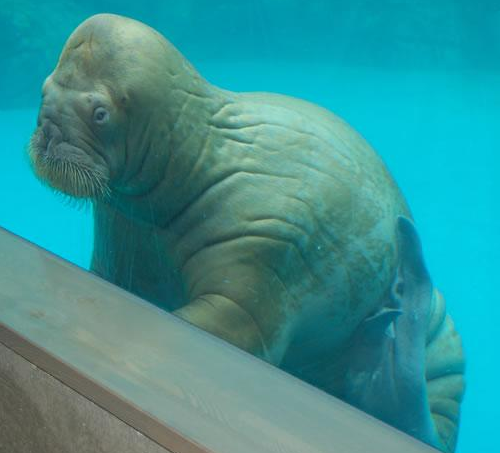
Orknies are creatures most commonly encountered in the stories told in the courts, taverns, and brothels of Kars.  These tales most commonly concern unlucky women who marry a rich noble from the Northern Isles only to find out he's a blubbery, murderous thing whose castle is under the sea.  This is what counts in Kars as satire.

Fishermen in the Northern Isles know better.  Tales of Orknies, or as they call them the Sea Things, in those regions take a far darker turn.  It is said that the fiends waddle up to seaside houses at night and peer in through the windows.  Many say they've heard them muttering in some incoherent language which sounded both soothing and frightening.  Whenever a child or young maiden goes missing, Orknies are almost always blamed.  Some of the more disreputable and mad sailors claim they've sen a vast, underwater city in which the Orknies play with drowned children, but who can believe those drunkards.

To avoid being taken, coastal villages will often leave animal sacrifices on the beach in the hopes that those carcasses will satiate whatever dark pleasures the Orknies wish to indulge.  The Church has placed a ban on such action, believing that it is a Pagan rite whose days are long past.  Surely the God of Law would protect the innocent from molestation, say the priests.  The peasants are less convinced.

Those few who know of Orknies in the Dark Country primarily know them as a heraldic device.  Noblemen from the Northern Isles often ironically adopt them as their colors, a habit the majority of the West finds quaint at best and that the peasantry of Kars finds sickening.

Orknies
No. Appearing: 1 (3d6)
Armour Class: 14
Hit Dice: 2+2
Move: 60'/120' (swim)
Attacks: 2 (flipper 1d4 and see below), or Gaze (see below)
Morale: 6
Alignment: Neutral

Orknies are bloated, blubbery monstrosities possessing a vaguely humanoid shape and terrifying appetites.  They stand roughly half a head taller than a man, and  their gate is a gross, undulating waddle.  Some scholars claim they are sexless, but others claim that the presence of something resembling facial hair on some points to a difference between male and female creatures.

Despite their generally clumsiness on land, Orknies can be eerily silent when they want to be.  At night or in other dark places they gain surprise on a 1-3 on 1d6.  They are found of dragging off victims -- usually young children or beautiful maidens.   Their beady, imbecilic eyes posses a strange power, and any human or demihuman 1 or less hit die must save vs. paralysis or be unable to move or speak for 3d6 rounds.  The Orkney may make two attacks with its flippers.  If both hits are successful, the target is grabbed and silenced (since Orknies always make sure to wrap one of their flippers around the victim's mouth).  Before entering the water they employ an air-tight bag made of an unwholesome, leathery material that both muffles the victim and provides he or she with what scholars believe to be an endless amount of breathable air.  These devices, when captured, do not seem to work in the hands of non-Orknies.

Orknies are cowardly beasts, and will usually flee at the first sign of armed resistance; however, if they have any victims grabbed they will not release them unless slain.  What they do with the poor women and children they take to the depths is best left to the imagination, for the reality is far too terrible for this blog post to relate.

EDIT:  It has come to my attention that I have neglected their unnerving habit of tapping on windows during stormy nights.  There. Now you know they do that.