Part 1
Part 2
In part one I discussed what I thought the failings of Nightwick Abbey were and in part two I discussed it's key strength, strangeness, as well as what I will be changing if I continue to develop it for play. Now I wish to discuss possible venues for my campaign dungeon.
The most pressing question facing the future of the demon-haunted abbey is whether or not I'll use it again for my current gaming group. While I hope to be in Knoxville for the rest of my graduate experience, this largely depends on whether or not I can secure funding here for the PhD program. As such, it seems possible that the Greyhawk campaign might be the last thing I do with this group.
If I do manage to get funding, it could mean I'll be in Knoxville for several more years. If that is the case, it's possible that the Greyhawk campaign might wind down or become a stale and the players and I will decide to visit something else. Whether or not this ends up being Nightwick Abbey at least partially hinges on how much of the material I end up folding into my version of Castle Greyhawk. On the one hand, I want to maximize the usefulness of the material I've already developed. I envisioned Greyhawk as a more low maintenance project largely made up of the re-flavored carcass of my old dungeon.
However, this is proving to be far from the case. While zany, Greyhawk is much more in the vein of "classicist fantasy," to borrow a phrase, as opposed to Nightwick Abbey's romantic/gothic streak. Granted, it still contains much of the mythic underworld in it, but the goblins and orcs who dwell with in mate in the usual fashion and are motivated by more or less the same (base) desires as the humans. While I think this makes for a more unique dungeon, it does cut down on the re-usability of much of the Nightwick material.
This is both a good and a bad thing for Nightwick Abbey. It's good because it means that Nightwick's material will stay in Nightwick. If it was duplicated too much in Greyhawk, it'd be unlikely that I would run it again in the near future. Since I won't get to use some of my ideas they'll stay fresh if the dungeon should see play again. It's bad because it means I have to spend more time developing Greyhawk Castle, and I can't devote as much time to fixing Nightwick Abbey's problems and drawing up knew levels beneath its tumbled ruins.
One possible venue then could be google+; however, I'm fairly busy as it is and running anything more than the occasionally side game would probably end with my having a heart attack. Still, I'll at least think about running a one-shot or two online.
Online gaming becomes much more attractive if I'm forced to leave the Knoxville area. I have a fairly large following (for which I am extremely grateful) and I imagine that if I was deprived of a group I could leverage that into a semi-regular online game. I used to be much more dismissive of online play than I am now, especially after I saw how well it worked with my skype-based Traveller game.
There is also the possibility of publication. This is highly unlikely outside of a free download or some shitty pamphlet I freely distribute myself. Nightwick Abbey relies far too heavily on others materials, notably the very excellent dungeon geomorphs the OSR has been so amazing at producing. As such it would require extremely heavy editing before I could produce it in a form that I'm both happy with and that doesn't piss off someone with access to lawyers. If I manage to produce further material on Nightwick Village, I may include some notes on the dungeons various levels and specials. These will not include maps and I'll attempt to avoid any actively AD&D material.
At this point, everything is up in the air. I'm running a bit longer than I wanted to, so I will discuss the inspiration for Nightwick Abbey in part 4.

Showing posts sorted by relevance for query Nightwick. Sort by date Show all posts
Showing posts sorted by relevance for query Nightwick. Sort by date Show all posts
Wednesday, September 28, 2011

Monday, June 26, 2017
Mastering the Megadungeon

Several months ago I got the idea for this post when a person on the Swords & Wizardry G+ group asked for advice on making a megadungeon. I have two - Nightwick Abbey and Uz's Undercity - and I have run them quite a lot. By my (probably flawed) math, I have run Nightwick alone for more sessions than James ran his original Dwimmermount campaign and online playtests combined. My online group often asserts that megadungeons are my bread and butter. Presumably I've learned something about making them and running them in all that time, and this is my attempt to try to organize that learning.
A megadungeon needs a theme. The standard theme is, of course, "a wizard built it for weird wizard reasons." That is a fine one and allows for a wide variety encounters, tricks, and traps, but for reasons I will reveal later I don't think its necessarily the best idea. I think you need something stronger - more particular to the dungeon. Make sure the theme is something that speaks to you. It needs to come from some kind of media you don't mind revisiting to draw from the well when you're not in the mood or stuck for ideas. For me that meant horror movies.
It is also important for levels and sublevels to have themes that, while tied to the dungeon as a whole, make them unique. One of the bigger problems with the first version of Nightwick Abbey is the first level showed all of its cards too early. The "new"* version instead has much more themed levels - a cloister, a garden, torture chambers, catacombs, etc. - that help the DM and the players keep from getting bored. It also means there's a greater sense of discovery because either the thing you discovered is new and interesting (a new level with a different theme) or it hints at something about the level currently being explored.

The Player's Map of First Level of Nightwick Abbey. Letter Designations were Assigned by Players.
I use geomorphs for Nightwick and the Pettigrew Papers for Uz, and both of these sources allow me to have micro-themes within the bigger themes of the level and the dungeon. In the case of Nightwick Abbey each geomorph has a broad description of what it is before I start stocking it. The geomorphs have since become fairly obvious to the online group - who keep track of their divisions, but I'm not so much bothered by that. Geomorphs are a very easy way to Jaquays your dungeon.
Stocking algorithms are incredibly important to the way I design dungeons and run games in general. The main reason I use them is the help keep the voices in my head quiet, but I think its worth commenting on how they affect my games. Once I have assigned a geomorph/pettigrew complex a theme I divide the number of rooms in it by three (always rounding up if I have to). That gives me the number of rooms with monsters in them. Then I use Courtney's Treasure Tables to generate an equal number of small caches (1d3 treasure parcels each). Half of these will go in rooms with monsters, a quarter of the ones without monsters will be trapped, and a quarter will just be free treasure. If the theme of the geomorph/complex necessitates a boss monster then I will increase their treasure parcels to the 4 + 1d4 - 2 one. I give each geomorph or complex a special if I can think of one. If I can't think of one then in the case of Nightwick Abbey I don't sweat it that much because Nightwick's entire operating mode is a special.**
On the level map I posted there are only maybe two truly empty rooms. Only 1/3 of the rooms have a monster encounter, but the rooms without them often have elaborate decorations or clues as to the nature of the dungeon. These are usually based on the geomorph, level, or dungeon theme. This is why it is important to have a very personalized theme: when you're stocking an 80 room level, eventually you will run out of ideas; however, if the themes you've picked are resonant enough with your brain you should be able to fill in the gaps with something. It also important to remember that something is better than nothing. All D&D is hackwork and a half-assed idea that gets your game on the table is better than a perfect one that takes months.

Imma Stock all the Rooms!
Back in the dim antiquity of 2009 when I first started thinking about the dungeon that would become Nightwick Abbey, there were a lot of hot takes saying that megadungeons needed to be huge. At the time I felt that Nightwick was too small but was unwilling to enlarge it due to laziness. Then I ran level one. For five years. ~77 rooms got me about 5 years of play without my needing to make a second level (though I kept promising I would). Experience with the Uz Undercity - which is a little less traditionally designed - has convinced me that 60 - 80 rooms a level is plenty mega for players to get lost and have plenty of options to explore. I wouldn't advise trying to get by with just one level, but the current version of Nightwick has 2 60 - 80 room levels and two ~30 room sublevels. This has been enough prep that I haven't touched it in two years and it seems like I may not have to for a long while yet.
One thing to remember is to restock your content. A simple version I use is that a room restocks on a 1-2 on the dice. The first week after the room has been explored you roll a d20, the next week a d12, then a d8, then a d6, then a d4 and you roll that d4 for each additional week until it restocks. This has worked very well for me, when I remember to do it.
I'll end with some pictures of my "Nightwick Abbey Prototype" - the graph composition notebook I keep my dungeon notes in.


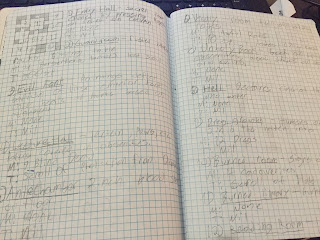
*It is some years old.
**It's a living dungeon that shifts when the PCs do things it doesn't like.
Monday, August 15, 2011
FLAILSNAILS Conventions for Nightwick Abbey

As a signatory of the FLAILSNAILS Conventions I have decided to put up a very rough and somewhat preliminary conversion guide for the current incarnation of the rules used in the Nightwick Campaign. For now I'm assuming one is coming over from a version of TSR D&D, but I'm open to other options.
- Character Abilities: PCs will use ability score adjustments from Labyrinth Lord. These bonuses do not cover any activities not covered in the core book.
- Races: the Nightwick Campaign currently uses a Race as Class system. Your character becomes the racial class available in the Dark Country that is closest to your character's race. Elves and Half Elven characters always become Changelings, while Halflings and Hobbits grow beards, develop an intense desire to make shoes, and generally become Gnomes. Others shall be decided on a case by case basis.
- Classes: The following classes are available in the Nightwick Campaign: Assassins, Clerics, Druids, Fighters, Magic-Users, Paladins, Rangers, and Thieves. All classes operate as explained in the Advanced Edition Compendium for Labyrinth Lord. Fighters are the exception and gain Multiple Attacks as per Swords & Wizardry. Racial classes include Changelings, Dwarves, Froglings, and Gnomes, but see races (above) for handling non-human characters. In the event that you're converting an Illusionist you may pick whether your character is a Magic-User or a Changeling.
- Rules Cyclopedia Special Case: Lawful Fighters being brought in from the Rules Cyclopedia may choose to be Paladins for the duration of the game. Neutral Clerics from the RC may enter play as Druids.
- Hit Dice: All characters roll all of their hit die as if they were making a new character at whatever level their character currently is. Use the Advanced HD option from the AEC. Do not reroll 1s.
- Secondary Skills: Each Character begins with 1 secondary skill from the AEC. This is rolled randomly.
- Alignment: Each character is either Lawful, Neutral, or Chaotic. The vast majority of imported characters will be Neutral (meaning they are polytheists and not dicks). Chaotic characters will only be those who actively worship the various Demons that exist in the Nightwick Campaign. Lawful characters must worship the God of Law, and it is suggested that in previous games the character worshiped a Lawful or Lawful Good deity such as Heironeous or St. Cuthbert.
- Character Languages: Languages operate as they do in LotFP:WFRP. Treat the character as if they have never encountered a language other than Common or their racial language before.
- Age: Character age as though the character is brand new in the Nightwick Campaign as per the AEC. However, if the character suffered any aging affects in previous games, these still apply.
- Multi-Classing: For simplicity's sake, multi-classed characters entering the Nightwick Campaign must pick which class they really are.
- Equipment: The character begins with any equipment they had in the previous adventure (or its closest AEC equivalent). However, they lose all of their gold coins upon entering the Nightwick Campaign (Dark Country taxes are rough). The character may begin with 3d8 gp in order to buy some equipment they think they may need for the adventure, but that option is for sissies.
- Spells: Spells function as they do in the AEC. Incoming Magic-Users begin play with a number of spells in their spellbook equal to the number of spells they can cast per day unless they are level 1. If they are level 1 they begin with two first level spells and one second level spell. In addition they also begin play with Read Magic. They cannot cast anymore than they could under standard LL rules. These spells are rolled for randomly by the judge (if he has enough time) or the player (if he doesn't). Changelings use the illusionist spell list.
That should just about cover it. It'd be unlikely that these rules would be used at the actual table, since my group meets at one of my players' homes; however, they would definitely be in effect if I ever offered to run Nightwick Abbey for Constantcon.
It is possible that I might make an online version of the Abbey use a different rules set (either straight up OD&D + Houserules or S&W) in which case I'll post a different set of conversion rules.
Wednesday, October 19, 2011
Nightwick Abbey in Hindsight Part 4
Part 1
Part 2
Part 3
Now comes the fourth and final part of my retrospective on the Nightwick Campaign. While it was rather short, only about 25 sessions, It was the culmination of ideas that extended back at least to 2008. The name Nightwick originally belonged to a castle on a map I made for a campaign I never ran.
When all of this OSR stuff was still starting up, my players were divided between die hard 3.x fans and die hard 4e fans. All of us began gaming early in my highschool career, which was the heyday of 3.5. I mentioned in my first post that some rather peculiar circumstances led me to be interested in OSD&D despite the fact that I did not spend my formative years playing it. The OSR added some fuel to this fire, and I had already tried to get them into OSD&D with a failed Castles & Crusades Wilderlands campaign, but the rest of my group found my fascination with it rather alien.
I would, as I still do, make hex maps for games I would ultimately never run since I mostly ran 4e in a heavily modified version of the Wilderlands at that point. While making one I used a random generator to determine some settlement names. One of the results was Nightwick Castle. I thought the name was cool, so I kept it in my mind for future use.
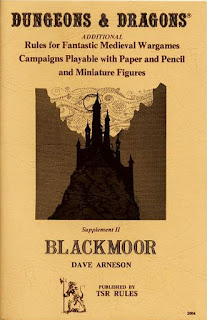
Then one day I was wasting time between college classes, listening to Sabbath and looking at OSD&D blogs. The particular song was "Black Sabbath" from their first album, and I happened to be in the middle of it when I saw this picture:
Part 2
Part 3
Now comes the fourth and final part of my retrospective on the Nightwick Campaign. While it was rather short, only about 25 sessions, It was the culmination of ideas that extended back at least to 2008. The name Nightwick originally belonged to a castle on a map I made for a campaign I never ran.
When all of this OSR stuff was still starting up, my players were divided between die hard 3.x fans and die hard 4e fans. All of us began gaming early in my highschool career, which was the heyday of 3.5. I mentioned in my first post that some rather peculiar circumstances led me to be interested in OSD&D despite the fact that I did not spend my formative years playing it. The OSR added some fuel to this fire, and I had already tried to get them into OSD&D with a failed Castles & Crusades Wilderlands campaign, but the rest of my group found my fascination with it rather alien.
I would, as I still do, make hex maps for games I would ultimately never run since I mostly ran 4e in a heavily modified version of the Wilderlands at that point. While making one I used a random generator to determine some settlement names. One of the results was Nightwick Castle. I thought the name was cool, so I kept it in my mind for future use.
Then one day I was wasting time between college classes, listening to Sabbath and looking at OSD&D blogs. The particular song was "Black Sabbath" from their first album, and I happened to be in the middle of it when I saw this picture:

Now, I had seen that cover 1,000 times before, but something about the juxtaposition of the spooky castle, the devil music, and my boredom inspired me. I began to think about what kind of setting that castle would exist in, and I remembered an intro to a computer game I enjoyed.
The line at the end "must face the demons it unleashed" really got my brain going. I imagined the milieu being essentially a stand in for the Baltic, with the Sword Brothers replacing their earthly namesake. At various periods I thought of them as either being a crazed death cult (for a BRP game) or an army of vampires (for an abortive 4e version of Castlevania). As my regular readers will already know, I eventually decided that the Sword Brothers no longer existed, having been quashed long ago by those who realized how evil they truly were.
I decided to revive the name Nightwick Castle, but I also combined it with some old notes I had for another dungeon. That other dungeon was also centered around a group of warrior monks who were corrupted by some evil power. That dungeon was my write up of Gardmoore Abbey (sp?). It's a small dot in the 4e DMG's map, and I can't check the information contained therein since I recently sold off most of my 4e books. I decided to smoosh the names together giving me Nightwick Abbey.
Over time I was able to wear my group down and convince them to let me run the setting using Swords & Wizardry. Those early sessions didn't use Nightwick Village, Lichegate, and the Abbey. Rather, I set it in an area that was somewhere near the abbey. It consisted of Hommlet sans the moat house which I replaced with Dyson Logos's The Necromancer's Garden, which I stocked with heavily reflavored monsters and demons.
Eventually the group changed to WFRP 2e, which most of us were happy with and the Nightwick campaign area (which had no name besides Nightwick at that point) went into hibernation. It only exited its cave when I moved to Knoxville and started this blog. The rest of its history can more or less be seen by reading my old entries. I'm not really sure at what point I dropped my Baltic setting and replaced it with this, but the switch to a Transylvania inspired landscape allowed me to keep the themes of the setting and gave me more mountains. I like mountains.
One final note: the name The Dark Country is actually a quote from the really shitty movie Howling 2: Your Sister is a Werewolf. When the protagonists are leaving to head to Transylvania, Christopher Lee referred to it as the Dark Country. I thought that sounded pretty cool.
Edit: I should also note that the Halloween season has caused me to miss the Dark Country something fierce.
Edit: I should also note that the Halloween season has caused me to miss the Dark Country something fierce.
Tuesday, August 2, 2011
Nightwick Village Minisetting Part II: Important Locations
1. Lord Eckhard’s Manor – Lord Eckhard (L Fighter 6) is a stout, boisterous man with a grey speckled beard and a loud voice. His small manor house is the best defended building in Nightwick Village and houses him, his family, and 40 men-at-arms. Eckhard is a good judge of character (70% chance to guess alignment) and will always trust Lawful characters and the company they keep. He possesses a fine (+1, non-magical) suit of Plate armor and a magical +1 greatsword named Winter. His “lovely” daughter is easily mistaken for an orc and is still a virgin.
2. Halfdan’s Tower – Halfdan the Black (C Magic-User 9) tries to stay out of the day to day business of Nightwick Village, preferring instead his collection of animated cadavers. He rarely leaves his tower, instead sending bewitched animals to conduct his business in town. This usually involves stealing corpses or other unsavory items. Halfdan hates Bishop Notker the Unshaven for exiling him from Lichegate. He will show immense interest in any party that is searching the ruins of Nightwick Abbey or actively working against the bishop. He will loan out his services to such adventurers, though eventually he will demand compensation.
3. The Medusa’s Head – This cozy inn is the only establishment where one can purchase alcohol in Nightwick, except for Rupert's cart. It’s proprietor, Bruno (L Fighter 4), is a retired adventurer who wished to set up an inn with his wife. She left him to join a Frogling circus and he has never forgiven her. Under the bar Bruno keeps three throwing axes he can hurl to great effect (+2 to hit and damage) as well as a broadsword he has named Damekiller. A bard (N Changeling 2) will sing hauntingly beautiful tales about the last war each night, much to the delight of Bruno’s guests. Most of the cliental are Eckhard’s men-at-arms; however, adventurers, traders, and woodsmen clutter the overly small common room in the cold months.
Bill
Ale 1 ep
Beer, regular 1sp
Beer, Frogling 1gp
Wine 1ep
Meal, common 1 ep
Common Room Floor 1sp
Private Room 10gp (1d4 available at any given time)
4. Blacksmith – Duncan (N Fighter 1) is a simpleton who can make excellent arms and armor as long as the customer does not want them monogramed. He can neither read nor write; however, few in Nightwick would take advantage of the poor man. His goods, while ugly, are of the highest quality, and all who have ever taken advantage of his low intellect have me t with a bad end. His mother was a witch who placed a spell on him when he was a young boy. Anyone who takes advantage of his stupidity will take a -2 penalty to all saving throws for one year. If someone were to kill Duncan, three Dretches would appear each night and attempt to slay the murder. They would appear until they were successful, adding one to their number on each attempt.
5. Ranger – Randulf (N Ranger 4) acts as a guide and protector for the woodsmen who operate outside the village during the day. He carries a quiver of regular arrows as well as 20 +3 Wolf Slaying arrows. These work against regular and magical wolves as well as werewolves and most other varieties of wolf-like creatures. Randulf is not a fan of the Church of Law, but operates against it subtly and will not refuse service to someone solely based on their religious affiliation. If someone attempts to convert him, however, he will often leave them to die in the forest.
6. Frogling Merchant – Rupert (N Frogling 3) maintains a cart in the village commons even during non-festival months. He sells potions for exorbitant prices and other goods at reasonable ones. During the fall and winter he becomes sluggish; however, this does not affect his ability to haggle. Rupert is a distant relative of the head of the van Toad house and enjoys a steady shipment of fresh goods.
7. Church – This small church is actually just a peasant’s hut with a cross on top. Originally Nightwick Abbey was to serve as the Church for the people of Nightwick Village; however, recent events have obviously made this impossible. Now this makeshift house of the God of Law is run by Father Roderic (L Cleric 3) and two acolytes without spellcasting ability. Roderic offers cure spells to the faithful for free and is very lenient on who qualifies as the “faithful.” Due to this leniency he is not very popular with Bishop Notker, who constantly seeks to replace him with a loyal toady. Thus far no one has accepted the dubious honor. The Acolytes sell Holy Water, and it is the only place in town where this can be purchased. The Church is based around the finger bone of St. Gax which was supposedly saved from the Abbey before its ruin.
8. Woodsmen’s Lodge -- This lodge houses some 50 woodsmen (Normal Men) who gather various forest products during the day. The hall is usually empty since the woodsmen prefer the food and drink of the Medusa’s Head to those found in the Lodge. On certain days of the lunar month, the pagan woodsmen fill the hall and perform rituals in secret to placate the various spirits of the Fogbound Forest.
9. The Old Wall – The wall around Nightwick Village is in terrible disrepair. Only a small section of it is capable of being manned. The rest has been hastily put together out of the remnants of various abandoned huts and houses. It has served the town well, though they rarely suffer more than a small raid from one of the goblin tribes in the Fogbound Forest. No one knows whether the wall would stand against a host of undead from the Abbey.
10. The River Deep – This tributary to the Dark River provides the majority of the water for Nightwick Village. It runs through a patch of Devil Vine that often glow a color outside of our spectrum (mauve) at night. Those who use the water typically boil it first, and so far no one has shown ill effects from drinking it.
11. Graveyard – This graveyard has fallen into disservice since the Sword Brothers began worshiping the foul things that sleep beneath the Abbey. During those dark times, monks and magicians in the service of the Brothers would cart bodies away from the cemetery in the night for some unholy purpose. Now it has more or less returned to the Fogbound Forest. Vines and trees grow straight out of graves, toppling over headstones and moving the contents of one grave below a different marker. Digging through the graves has a small (25%) chance of turning up a body (10% chance to animate once uncovered, 30% chance of having grave goods of treasure type determined by the judge).
12. Graveyard – this new graveyard has seen few burials. Instead, locals typically bring bodies here to burn them on funeral pyres. While many passing servants of the God of Law find this barbaric, the adherents within Nightwick Village see it as a necessary evil.
Wednesday, April 5, 2023
The World is a Haunted House

Some time ago I was in a conversation with Cole about Nightwick in the very pretentious way I sometimes do and the topic veered into the definition of "Dark Fantasy." It's a genre which I think there is no question that the World of Nightwick occupies, even if it's not always serious. It's also a genre which, 13 years after I first started running Nightwick still has a lot of cultural cachet. If anything it's gotten bigger in this post-Dark Souls/post-Elden Ring world, and I think for someone who works in that medium, even if it's all hack work, it's worth thinking about what it is.
Normally it is defined as "fantasy with horror elements," but very commonly Moorcock's Elric saga is included in Dark Fantasy and I wouldn't say it has horror elements. Cole provided a definition that I think does the wonderful job of including the things people would want to include and excluding what they wouldn't while also being very evocative: Dark Fantasy is fantasy that takes place in a world that is haunted.
What does it mean to be haunted? Probably at least in part because of my history background, I am going to be using "haunted" here to mean that it bears the scars of the past - a psychic shock that causes the memories of the dead to cluster there like bats in a cavern and for them to weigh as a nightmare upon the brains of the living. In thinking about this topic outside the realm of games, I have come to see history writing as a sort of ghost story. The crimes of the past have a long reach and haunt us today as much as any specter from the mind of MR James.
In our fantasy game worlds, or fantasy worlds in general, we can achieve this sense of being haunted through the numinous. The psychic scars of the past have physical and spiritual manifestations on the world. In the world of Nightwick, immediately to the northwest of Nightwick Village, is the Mire of Princes - created when the blood of an army facing the Sword Brothers so suffused the ground that it became a marsh ever after. More distantly there is the Blood Red Sea - stained that color after the demon Moloch pitched the men of ancient Acheron into it. And of course there is Nightwick Abbey itself.
Within Nightwick Abbey's hall, the sins of the Sword Brothers live on in twisted and exaggerated form. Tortures carry on forever, heedless of the death of both torturer and tortured. Hochmeisters of the past walk evermore beneath its ruins, returning again if slain for they are trapped forever. Even what was once a lavatory has taken ghastly shape in hideous memory of the room's previous purpose. Nightwick is, after all, a mythical underworld.
If you want to run something that's Dark Fantasy, as seems to still be in vogue, that's how you do it. Think about the history of the setting and how its crimes gnaw away through time into the present. It is a mode of thinking that should be easy to all of us now.
There are times when I desire to run something where the world is less numinous - a lower fantasy where heroes of maybe a Howardian stripe come to grips with monsters of super science - but then I have to write dungeon rooms. It seems my brain is either too choked by the weeds of time and the study of past wrongs or too enamored with the gothic I engaged with in entertainment and saw in the woods where I grew up. But my dungeons are always haunted. Maybe I am too.
Thursday, October 4, 2018
NPCs of Nightwick
NPCs in and around the Village of Nightwick:

Sir Albrecht
Albrecht is the current "Lord of Nightwick," a semi-recently created title that was held by Lord Eckhard before his demise. He has recently taken over the village from Badder on behalf of Bishop Notker the Unshaven (see below). He has staffed the local manor with his family and personal retinue, who guard it diligently. He seems to run a tight ship, and is never seen in the village without a number of guards. He recently made a deal with the Howling Kommandos that subsidizes their pay for watching the village.

Aythe
A recent arrival in the village, Aythe speaks common with a strange, halting accent and claims to be Halfdan the Black's long lost daughter (see below). The party has reason to suspect that she is actually his "bear-wife" made human by machinery they recovered from the ruins of the abbey. She spends much of her time in the Fog-bound Forest and local cemetery.

Bruno
Bruno is the proprietor of the Medusa's head. In the early years of the campaign he seemed morose over the fact that his wife left him with "a traveling circus," but he seems resigned to this fact now. Local rumor says his wife was a changeling of foul aspect. His tavern was semi-recently the sight of an assault on one of the brothers Trull by a witch who was later slain.

Duncan
The local blacksmith is a man of simple mind and great talent. Duncan is said to be the son of a local witch (now deceased, and not the witch which attacked one of the Trulls). Villagers believe a spell lays upon him and that any who try to cheat him based on his simple mindedness may find themselves cursed or even pursued by demons. His craftsmanship lacks ornamentation but is without peer in the Dark Country in terms of practical use. Unfortunately, the time it takes him to make weapons and armor is often great due to the troubles in Blackleg and along the Long Road.


Sir Albrecht
Albrecht is the current "Lord of Nightwick," a semi-recently created title that was held by Lord Eckhard before his demise. He has recently taken over the village from Badder on behalf of Bishop Notker the Unshaven (see below). He has staffed the local manor with his family and personal retinue, who guard it diligently. He seems to run a tight ship, and is never seen in the village without a number of guards. He recently made a deal with the Howling Kommandos that subsidizes their pay for watching the village.

Aythe
A recent arrival in the village, Aythe speaks common with a strange, halting accent and claims to be Halfdan the Black's long lost daughter (see below). The party has reason to suspect that she is actually his "bear-wife" made human by machinery they recovered from the ruins of the abbey. She spends much of her time in the Fog-bound Forest and local cemetery.
Bruno
Bruno is the proprietor of the Medusa's head. In the early years of the campaign he seemed morose over the fact that his wife left him with "a traveling circus," but he seems resigned to this fact now. Local rumor says his wife was a changeling of foul aspect. His tavern was semi-recently the sight of an assault on one of the brothers Trull by a witch who was later slain.

Duncan
The local blacksmith is a man of simple mind and great talent. Duncan is said to be the son of a local witch (now deceased, and not the witch which attacked one of the Trulls). Villagers believe a spell lays upon him and that any who try to cheat him based on his simple mindedness may find themselves cursed or even pursued by demons. His craftsmanship lacks ornamentation but is without peer in the Dark Country in terms of practical use. Unfortunately, the time it takes him to make weapons and armor is often great due to the troubles in Blackleg and along the Long Road.

Fingers
Fingers is the second in command of the Howling Kommands, and received this honor when he strangled his former comrade Toothless Tom Smiler to death when he tried to betray the party in the ruins of Vollage. All observers note that he is extremely loyal and deferential to Stavros, the current commander, and has become something of a siege tactician. He also knows his men's strengths and weaknesses inside and out; however, he is sometimes impotent in controlling them due to their low discipline and morale.


Father Roderick
Roderick is currently the official priest of Nightwick. Life in this backward land, and his frustration with the obvious graft and greed of Bishop Notker, has made him a cynic and a pessimist. Roderick is, to the bishop's mind, overly tolerant of heresy and paganism, but since he has not espoused heresy himself he has not been removed. He is served by two monks who have taken a vow of silence.

Halfdan the Black
This wizard has lived outside the village in a tower at the edge of the Fog-bound Forest since anyone living in the village can remember. He seems to be a necromancer of considerable power, as no local authority has yet moved against him. He seems more interested in experimentation than political dominance, and his erratic personality may make it impossible for him to maintain evil schemes for too long. He has often employed adventurers to bring him "samples" from Nightwick Abbey. He used to have a black bear that lived in the tower with him and attended to his needs - referred to by the party as his "bear-wife" - but she disappeared around the time Aythe showed up.

Mervyyn
Mervyyn was once an adventurer, but he gave that life up to help protect the local village from the depredations of the creatures of Nightwick Abbey and to devote himself to the Old God Father Winter (see below). Since his given up the adventuring life, he often waits outside the dungeon to great those who seek to plumb its unknown depths.

Low Deacon Osprant of Prattle
Osprant was sent by Bishop Notker the Unshaven to observe Roderick and determine if he was saying anything heretical. After taking copious notes, he determined Roderick's sermons were orthodox, if somewhat noncommittal. He has sent messengers back to Lychgate but doesn't plan to make a report in person until the weather is colder and the roads and swamps harden for easier travel. He is, by all accounts, a turd.

Randulf
Randulf is a woodsmen and friend of the Woodsmen's Lodge, though seemingly not a member of it. He acts as a guide for them during their longer trips into the Fog-bound Forest. The respect they have for him is rivaled only by their respect for Kozel in his role as priest of "Saint Santa Claus." He has seemingly avoided the party every time they have tried to contact him.

Rupert van Toad
Rupert is the local representative of the van Toad trading house who long had to hawk his wares outside the village walls. Thanks to both the greed of the bishop and the agency of the players, Rupert was able to move his shop inside after Lord Eckhard was lawfully slain and replaced with the "reeve" known only as Blackbird (now also deceased). In the spring and summer months he is known for his quickness and joviality while in the fall and winter becomes slow and listless.
Major NPCs Elsewhere in the Dark Country:

Anne of Waldheim
Anne has been widowed twice. She moved to Blackleg when her husband, Arn of Waldheim, took the city during an extremely intense "Yimslite" rebellion. Her husband was murdered under mysterious circumstances - many speak of the involvement of both the sinister Brotherhood and Bishop Notker himself. She became Notker's ward for a sort time before being married off to the most recent Lord of Blackleg, Baltzer the Bold. Baltzer recently perished either due to the actions of his wife or the vengeful shade of Arn, no one knows for sure. In either case, she is once again the ward of Notker but also the only authority in Blackleg. Abraham Nermal, deformed rogue and vassal of the Bishop, hopes to win her hand in marriage.

Arnawald the Black Eagle
Arnawald is a man of brutal reputation. His desire to make himself the sole lord of the entire Dark Country is obvious and has placed him in a kind of cold war with Bishop Notker. He has invaded the Bishop's territory twice, but ostensibly to "aid" Notker against either the White Lady's pig-men or Yimslite rebels (see below). During the second incident, he was able to capture the town of Blackleg, which he gave to his son Arn, and the villages south of Nightwick Abbey. He planned further campaigns but was stopped when the release of Father Winter caused a blizzard in July, killing many of his men. It is said he still holds a grudge against Father Winter. Neither he nor Notker seem willing to declare open war yet for mysterious reasons. He is known for his missing eye, which he leaves uncovered to unnerve those he is negotiating with.

Badder the Badger
Badder is a mercenary who has entered into what is essentially a permanent contract with Bishop Notker and the city of Lychgate. Lychgate has its own forces, but Badder and his "boys" act as the Bishop's personal group of troubleshooters and hitmen. After the death of Marta the Bitch, who Arnawald had installed in Knightpath, Badder came to Nightwick to campaign in the south and try to oust more of the lords that Arnawald had installed during his last campaign in the south. Whether or not he was effective is unknown, and he was recalled to Lychgate after losing many men and materiel. It is believed Sir Albrecht's postion as Lord of Nightwick shows that Badder is now on the Bishop's bad side.

Father Winter
Father Winter is an Old God who resides in the Fog-bound Forest and the Nameless Mountains, though he shares this territory with at least two other gods. He was entombed by the Sword Brothers during their campaigns against the pagans but freed by the party in order to stop a plague. The somewhat syncretic nature of religion in the Dark Country has led to him being associated with a "saint" named Saint Santa Claus.

Knecht Ruprecht
Ruprecht is a servant of Father Winter who deals punishment to those on the god's "Naughty List." He is the ultimate arbitrator of what is and is not Naughty - an axis of alignment not well understood by the Church of Law. He was transformed into a hideous monster by agents of Arnawald when they found a way into his shrine and wrote Father Winter's name on the Naughty List. The leadership of the Howling Kommandos saved him from this fate, and for their service he gifted them many magic items.

Bishop Notker the Unshaven
Notker the Unshaven is Prince-Bishop of Lychgate and as such technically rules Nightwick, Blackleg, and the villages in the Southern Dark Country. He is a petty, greedy man whose naked avarice is a constant source of woe for his subjects. In the years since 1388, his territory has been greatly diminished by attacks from the White Lady, Arnawald, and Yimslite rebels. He know can only effectively control Lychgate and Nightwick, but even the road between them is unsafe due to the destruction of Vollage and the absorption of the Witchfort into the Witchwood.

The White Lady
The White Lady is the Old God (or perhaps demoness) of the Witchwood - a realm of iron trees and perpetual autumn. Her servants are pig-men, groans, and haughty elves as well as all manner of woodland creatures. Once a great threat to the civilized parts of the Dark Country, she has seemingly abandoned her assaults in recent years after a small detachment of the Howling Kommandos entered the Fog-bound Forest. Only Flint of the East Wood (now deceased) returned, and he did not know the whole story.

Yim Yimsley
Yim Yimsley is a mysterious figure. He has apparently led many rebellions against Bishop Notker and Arnawald and seems to combine the Solarist heresy and paganism into a new kind of Dark Country religion. In his early years he mostly spent his time embarrassing the Bishop and his servants, but later his aims became more coherent and violent. After interrogating cultists inside Nightwick Abbey, the leadership of the Howling Kommandos believes he is involved in a satanic cult associated with the Bleeding Baroness.
Major NPCs Elsewhere in the Dark Country:

Anne of Waldheim
Anne has been widowed twice. She moved to Blackleg when her husband, Arn of Waldheim, took the city during an extremely intense "Yimslite" rebellion. Her husband was murdered under mysterious circumstances - many speak of the involvement of both the sinister Brotherhood and Bishop Notker himself. She became Notker's ward for a sort time before being married off to the most recent Lord of Blackleg, Baltzer the Bold. Baltzer recently perished either due to the actions of his wife or the vengeful shade of Arn, no one knows for sure. In either case, she is once again the ward of Notker but also the only authority in Blackleg. Abraham Nermal, deformed rogue and vassal of the Bishop, hopes to win her hand in marriage.
Arnawald the Black Eagle
Arnawald is a man of brutal reputation. His desire to make himself the sole lord of the entire Dark Country is obvious and has placed him in a kind of cold war with Bishop Notker. He has invaded the Bishop's territory twice, but ostensibly to "aid" Notker against either the White Lady's pig-men or Yimslite rebels (see below). During the second incident, he was able to capture the town of Blackleg, which he gave to his son Arn, and the villages south of Nightwick Abbey. He planned further campaigns but was stopped when the release of Father Winter caused a blizzard in July, killing many of his men. It is said he still holds a grudge against Father Winter. Neither he nor Notker seem willing to declare open war yet for mysterious reasons. He is known for his missing eye, which he leaves uncovered to unnerve those he is negotiating with.

Badder the Badger
Badder is a mercenary who has entered into what is essentially a permanent contract with Bishop Notker and the city of Lychgate. Lychgate has its own forces, but Badder and his "boys" act as the Bishop's personal group of troubleshooters and hitmen. After the death of Marta the Bitch, who Arnawald had installed in Knightpath, Badder came to Nightwick to campaign in the south and try to oust more of the lords that Arnawald had installed during his last campaign in the south. Whether or not he was effective is unknown, and he was recalled to Lychgate after losing many men and materiel. It is believed Sir Albrecht's postion as Lord of Nightwick shows that Badder is now on the Bishop's bad side.

Father Winter
Father Winter is an Old God who resides in the Fog-bound Forest and the Nameless Mountains, though he shares this territory with at least two other gods. He was entombed by the Sword Brothers during their campaigns against the pagans but freed by the party in order to stop a plague. The somewhat syncretic nature of religion in the Dark Country has led to him being associated with a "saint" named Saint Santa Claus.

Knecht Ruprecht
Ruprecht is a servant of Father Winter who deals punishment to those on the god's "Naughty List." He is the ultimate arbitrator of what is and is not Naughty - an axis of alignment not well understood by the Church of Law. He was transformed into a hideous monster by agents of Arnawald when they found a way into his shrine and wrote Father Winter's name on the Naughty List. The leadership of the Howling Kommandos saved him from this fate, and for their service he gifted them many magic items.

Bishop Notker the Unshaven
Notker the Unshaven is Prince-Bishop of Lychgate and as such technically rules Nightwick, Blackleg, and the villages in the Southern Dark Country. He is a petty, greedy man whose naked avarice is a constant source of woe for his subjects. In the years since 1388, his territory has been greatly diminished by attacks from the White Lady, Arnawald, and Yimslite rebels. He know can only effectively control Lychgate and Nightwick, but even the road between them is unsafe due to the destruction of Vollage and the absorption of the Witchfort into the Witchwood.

The White Lady
The White Lady is the Old God (or perhaps demoness) of the Witchwood - a realm of iron trees and perpetual autumn. Her servants are pig-men, groans, and haughty elves as well as all manner of woodland creatures. Once a great threat to the civilized parts of the Dark Country, she has seemingly abandoned her assaults in recent years after a small detachment of the Howling Kommandos entered the Fog-bound Forest. Only Flint of the East Wood (now deceased) returned, and he did not know the whole story.
Yim Yimsley
Yim Yimsley is a mysterious figure. He has apparently led many rebellions against Bishop Notker and Arnawald and seems to combine the Solarist heresy and paganism into a new kind of Dark Country religion. In his early years he mostly spent his time embarrassing the Bishop and his servants, but later his aims became more coherent and violent. After interrogating cultists inside Nightwick Abbey, the leadership of the Howling Kommandos believes he is involved in a satanic cult associated with the Bleeding Baroness.
Saturday, June 8, 2019
Characters for Nightwick Abbey
I plan on running a Nightwick game at my FLGS in addition to the Wilderlands game I started last week. I made some pre-made characters for it in case someone didn't want to take the time to make one and I gave them short backgrounds. I thought I'd share the backgrounds on here to give a sense of the kind of characters I imagine adventure in the Dark Country.
Note on alignment: Nightwick uses a 5 point alignment line: Lawful - Good - Neutral - Evil - Chaotic. Lawful and Chaotic characters must have magical abilities granted by the God of Law or some fowl devil respectively. Most humans are neutral but some may be Good or Evil.

Nestorios Parsimonios
- Nestorios Parsimonios is a sage and alchemist and aspiring wizard. His alignment is Neutral.
- Nestorios is from Zenopolis, the greatest city in the World and the last bastion of the old Empire.
- His father was also a wizard who seems to have had a child mostly to serve as an apprentice.
- He became fascinated by alchemy while reading his father's books.
- After his father finally died of a strange illness - unrelated to the strange substances he studied of course - he acted as an alchemist for some years.
- However Nestorios became bored and, after finding a text describing the strange state of the infamous Nightwick Abbey and its seeming shifting qualities, he has left for the Dark Country to observe these properties for himself.

Dame Ysentrude
- Dame Ysentrude is a Realmish noble and paladin. Her alignment is Lawful.
- Ysentrude was born to an impoverished noble family in the Realm of Man. Her family was once storied and powerful, but now her title is laughed at by the common folk.
- As the youngest daughter, she was likely going to be married to a noble of another kingdom, but the God of Law has shined his light on her and shown her family that she is destined for the life of a warrior.
- She has left her home to head to the infamous Dark Country in order to fight the Devilry there and make her name famed throughout the World.
- Luckily, the people of the Dark Country seem to think her family still has wealth.

Ermel the Dagger
- Ermel the Dagger is a Karslish Ranger and purported hero of the People. Her alignment is Evil.
- She was born in a cave in the Karslish Isles where her family was hiding from the brutal servants of a local lord.
- A holy man who lived in the woods near her village declared that she were destined for greatness.
- Ermel grew up stealing from both the forces of the evil lord and her fellow villagers, knowing that it was for her destiny.
- Finally she was caught and threatened with hanging by the Baron, but she was able to have a stay of execution on the promise that she would go on Crusade to the Dark Country.

Friar Schub
- Friar Schub is a Realmish cleric and hermit. His alignment is Good.
- He was born in the Realm of Man inside a monastery.
- Schub's mother died at birth and his father, a trapper, gave him to the monastery rather than raise him own his own.
- He eventually began to prefer the seclusion of religious meditation to his cell, but he would return after many days to harangue his brothers with fiery sermons.
- Recently, the Lady herself appeared to him and told of the Great Evil in Nightwick Abbey and so he joined a caravan to the Dark Country and the village of Nightwick.

Oberich
- Oberich is a dwarf rogue and refugee from the Kingdom Under the Mountain. His alignment is Neutral. He is also a fine dulcimer player.
- He was born in the Kingdom Under the Mountain. When he was too young to remember, the Dragon came up from the mines and drove people to the four corners of the world.
- He lived thereafter with his parents in a series of rundown shacks as his father served as mason and goldsmith to various human lords and ladies.
- Oberich became jealous of the treasures of men, but decided that rather than indulge in this jealousy that he would go out into the wilderness and perhaps learn about the world before the coming of men.
- He traveled the forests, valleys, mountains, and especially caves of the World. Oberich spent much of it among the pagan folk of men or fighting goblins - the descendants of his brethren who turned to Devil Worship.
- Recently he has heard of the hoarded gold in the ruins of Nightwick Abbey. All gold beneath the Earth belongs to the dwarves, and he would seek to reclaim it.

Dirk
- Dirk is a Frogling fighter and criminal. His alignment is Evil.
- He was born in Hopland, the marshy home of the Froglings.
- His father abandoned him when he was young. While his mother could support he, he decided to turn to crime because he was bored.
- He quickly became a leg breaker for a local gang.
- He tried to moonlight as a highwayman, but his gang leader found out and put a hit out on him.
- He came to the Dark Country to find wealth in Nightwick Abbey, more wealth than he could ever have working for the van Grouch gang.
Thursday, February 3, 2011
Actual Play, Nightwick Abbey, the Underworld, and Gamer ADD
Warning: this one rambles a bit, but it's the synthesis of lots of ideas that have been whooshing around in my head recently and I needed to get them out.
Recent posts over at Grognardia have got me thinking about how awesome it is to see a campaign setting develop through actual play. I've seen this first hand with a Wilderlands of High Fantasy campaign I ran off and on for a large part of my undergraduate career. By the end of it our gaming group created and defined a slew of new cultures, reinterpreted existing ones, had characters who achieved apotheosis, established new dynasties in certain city states, and even saw the destruction of the CSIO due to a giant robot. These served as the basis for a very short term 4e game I ran, but it fizzled out largely due to my frustration with that system. Still, my version of the Wilderlands is wildly divergent from "canon" and 99.9% of that divergence came about as a result of the needs of actual play.
This shouldn't be that strange to anyone whose played any RPG for an extended period. Even if one uses an established setting -- as I did -- eventually the group will run into things that aren't cover or are only sparsely covered by the setting material. Still, one of the most exciting things about RPGs is seeing this kind of transformation of a setting through player action and DM development.
What James M. is talking about though doesn't just include the setting but also the rules. The above Wilderlands example pretty much used 3.5 (with the spell recharge system from unearthed arcana). What he is advocating, and he is right in doing so, is the development of house rules, adjoining systems, and supplements from actual play.
Originally I conceived of Nightwick Abbey as such a project. I'd start with the Swords & Wizardry White Box, build a big dungeon, a nearby, and a really rough sketch of the overall area it existed in. Then I'd start playing and build out from there. That changed partially when I started this blog, and then again when I ran into my current group of players. Now I use Labyrinth Lord with dabbles from Raggi's Game, the Rules Cyclopedia, and an increasing amount of AD&D. This was largely because the players had already played Labyrinth Lord and were currently playing AD&D, and partially because it's just the way I ended up doing it. I've discussed already the fact that I just like handling the AD&D books and that I like Gygax's prose. Stil, it's more or less by the book D&D, even if which book is a bit contentious.
The Underworld is a whole different animal. I'd still largely consider developing it on an ad hoc basis. Though I'd likely use the White Box for it as well, I may hold out to see what Brave Halfling Publishing's new Delving Deeper looks like. The main idea though is to use a skeletal version of OSD&D and build out from there.
I'd like to do this through play. Unfortunately it's unlikely that I'll run the Underworld in the near future. I've got a good thing going with my Nightwick Abbey group and I think these sorts of campaigns work best if they're designed for the long haul. I'd ultimately like to be a one setting/campaign man. If I ever DM for your group, it's gonna be X-thing-I've-been-working-on-for-years, assuming I ever figure out what that is.
The problem here is that I have one of the worst cases of GADD in recorded history. The aforementioned Wilderlands campaign has the distinction of being the only game I ever ran that stopped at a logical point. Even then, another DM had taken over and I was a player for the last few months. Just this week I've pondered running HarnMaster, Nightwick Abbey again, AD&D set in the Savage Frontier (I always seperate the Paul Jaquays book from the rest of the FR setting. Bullywugs riding dinosaurs!), Cthulhu Dark Ages, and now I'm sitting here thinking about how cool it would be if I could ever get a handle on the Underworld.
Part of Nightwick Abbey's success has been it's staying power. I thought of the concept about two years ago in a blinding epiphany that occurred while listening to the Black Sabbath song Black Sabbath while looking at the cover of Supplement II: Blackmoor. While I've only recently begun to run it regularly, it's been on my mind steadily for several years and no matter how far my mind wanders down the ADD path it always comes back to it.
So what does that mean for the Underworld? Obviously I'm not currently running it, and I'm not likely to. Perhaps I'd be better off devoting my attention solely to Nightwick Abbey. The thing is, that the Underworld concept is just as recurrent in my brain as Nightwick Abbey is. It's a bit more hazy and amorphous, but thats largely because it hasn't been set through the rigors of play that the Abbey has. The Underworld and Nightwick Abbey are permanent fixtures in my daydreams, and it'll be a long time before either of them is swept out.
So what does all this mean? Well I don't know yet. Perhaps the level of development I'll do for the Dark Country will make it the out and out winner. It'll become my Blackmoor/Greyhawk/EPT. Or maybe the party will wipe and be in the mood for something else. Bam! Here comes Underworld. Maybe I'll start an online Underworld game so that I can be developing towards something. Who knows? I sure don't.
Sunday, December 15, 2013
Musings on my home group and my DMing style
Last weekend, a member of my home group ran a one shot game using the final D&D Next playtest packet, and I have to say I was impressed. I found the system general simple enough for me to like it and also that several things it did, such as backgrounds and the way profeciencies work, closely mirrored things I have been wanting to implement in my S&W games as part of an attempt to make them more like WFRP. Naturally, I soon turned my thoughts towards how I would modify the system to run a Dark Country game for my home group.
But home groups are funny things. The G+ group that I've been playing with for the past two years, aside from being very patient with my constant flitting from one setting to the next, has also really really dug the Dark Country. This should come as no surprise as they're made up of people who saw my add for the Dark Country G+ game and went "that sounds awesome. Sign me up!" My Hattiesburg group is, instead, made up of close friends I've had since high school. Because the group is based around our friendship rather than our taste in particular kinds of fantasy games, this means there are some differences
Some players in my home group have never liked the Dark Country, and before last night I was never entirely sure why, even if I had inklings. Sure, some did, but the ones that didn't often were the ones who were most invested in the idea of playing D&D, so if they aren't having a good time it kinda drags the whole thing down. After discussing what I wanted to run with my players last night, I discovered the reasons that they don't like my Nightwick game.
The first, and this was primarily the complaint of a single player - though one who is, again, one of the ones who tends to get invested and thus his complaint is probably worth considering - is that my constant need to limit character options in an attempt to get a specific tone is damaging to game balance, since the game assumes that all options are in play. I don't particularly agree with this, since I think that D&D was, is, and hopefully will always be set up as a tool box for individual groups. Using all the tools in the toolbox is the quickest way to Boring Town imaginable, as it leads to the high fantasy nonsense one sees in post Forgotten Realms D&D. What you leave out is, at least to my eye, just as important as what you put in.
The other complaint, which I think was more broadly held, is that the Dark Country was too shitty, and that there was little sense of progress in the Nightwick Abbey games I've run for them. The most obvious reason for this is a problem I've noticed with my own DMing style over the last year or so: I treat the setting as a noose slowly tightening around the PCs' collective neck. This might not sound like such a bad thing, but I noticed in my Cocanha playtests of Feudal Anarchy that it lead to the G+ group sometimes feeling like they could take nothing but missteps, and in my G+ Dark Country game it eventually led to my having to advance the timeline of the setting by several months in order to avoid all of the adventures suddenly becoming solely about procuring food for the village of Nightwick. This is a problem, I realize its a problem, and I'm trying to figure out ways to fix it.
More importantly though, talking to my players helped me realize another issue they were having, and I think that certain G+ players such as Robert and Zak were having is that Nightwick Abbey's very nature means that one doesn't feel like any progress is happening. In other megadungeons, the dungeon is mostly a static environment. I don't mean that the monsters don't move or that there aren't active factions in the dungeon. I mean the dungeon itself isn't alive. Nightwick Abbey is. So in Greyhawk or Dwimmermount or whatever, clearing an area might not be permanent, but you at least feel like you did something. In Nightwick, on the other hand, the dungeon is still living and still mad at you and still vomiting up monsters, so there's little sense that anything got done, regardless of how much you mapped.
This is something I previously hadn't considered, and would explain my home group's general preference for Uz over Nightwick, even if it often contradicts the problem of limited player options I first identified. There's more of a sense of progress in clearing out a level of the Uz undercity.
Last night I discussed a number of possible options with my players, noting that I would prefer to run something that I made because the thing that I enjoy about the classic D&D settings is that they were created through play. The organizations and historical events in them are a combination of the creativity of the players and the DM, and that is super cool.
So initially I pitched the Wilderlands, since, for that group, there a large part of what I would be doing for that setting was created through play. In my old 3e game, several of their characters are legends if not out and out (minor) gods, and my wife destroyed a giant robot that was rampaging through the CSIO (my co-DM used the stats for the Tarrasque) by rolling 3 20s in a row* while only level 6, ensuring both the immortality of her character and, by the collapsing of the giant robot, the destruction of large sections of that famous city. So the changes made by player character action would, hypothetically loom large over any future Wilderlands campaigns.
But my tastes have changed since I ran the Wilderlands in college. Back then I was primarily interested in Late Antiquity, my intellectual imagination fired by the works of Walter Goffart and Patrick Geary, not to mention Jordanes and Bede. And while I do still clearly enjoy pre-medieval fantasy settings, my tastes, both intellectually and in terms of fantasy fiction, have turned more towards things related to the high to late Middle Ages. I like knights and guilds and medieval depictions of the Devil and fortified manors and even the Church. These are largely incompatible with both the Wilderlands as generally conceived, and, more importantly, the Wilderlands as it is likely remembered by my players.
So I'm not really sure what to do. My G+ players, particularly Michael, Huth, and Zzarchov, would likely prefer that I keep running the Dark Country (and to a lesser extent the Terran Directorate) until Christ in His glory comes to sit in judgement, and I greatly appreciate those players, but as Chris Kutalik has noted on several occasions, there is something about the experience of playing with a face to face group that is just better, even if G+ is a great deal better than other forms of digital gaming.
*I never remember if this was a houserule or an actual rule, but we always said in my group that 3 20s in a row meant that the thing was auto-dead regardless of other factors, much like the similar rule in EPT.
Subscribe to:
Posts (Atom)