Showing posts with label Campaign Dungeon. Show all posts

Monday, March 11, 2019

Mastering the Megadungeon Take 2: Tips for 5e

My First Megadungeon

My first attempt at this received some flak for using some Old School D&D blogosphere jargon terms.  I'm going to try to do better about that this time and make it more friendly for people who haven't been reading about these things for a decade now.  What better way to do that than to talk about how to make them for the latest version of D&D?

I am not going to cover why you would ever make a megadungeon in this post, but may handle it later if there is interest.  Instead I'm going to assume you already see the fun in exploring a big, weird space and in making one to be explored.  Based on your hypothetical desire to run this style of game, I'm going to assume you would benefit from a houserule: half xp for monsters but you get 1xp per 1gp of treasure found.  This will, hopefully, encourage players to spend resources going deeper into the dungeon to find treasure instead of trying to play the world's weirdest version of Rainbow Six.

Another assumption I'm making is that you want to follow the traditional megadungeon model where the level of the dungeon is roughly equivalent to the level of the PCs exploring it.  Unfortunately, this is difficult in 5e given the nature of low levels.  A fix I recommend (and that I use in the 5e version of Nightwick Abbey) is to have the first level of the dungeon have challenges for characters levels 1-3, and then each level after that is equal to one character (so dungeon level 2 is for character level 4, 3 is for 5, etc.).  If you have c. 70 rooms on a level this should work fine with the other methods mentioned in this post.

Nightwick Abbey was inspired by films such as the Blind Dead.

As I said in the first post, if you want to run your megadungeon for a long time and not get too bored with it, you're gonna need to have a theme that resonates with you.  The old "built by a mad wizard" potentially allows for a wide variety of potential content but may not grab you enough to work on it in the long term. My two most developed megadungeons (Nightwick Abbey and the Uz undercity) were based on the midcentury horror cinema I liked. A Tolkien fan might want to do a riff on the ruins of the Pits of Utumno or Angband. A fan of classic sci fi may want to do some version of the huge Krell machine in Forbidden Planet. Someone who is more familiar with the works of the big three pulp authors might want to base their dungeons on Mt Voormithadreth or the city in "Red Nails." There are a lot of possibilities but the important thing is that they resonate with you and are broad enough in terms of genre that you can draw from a wide variety of sources.

Once you have determined you're overall theme, you'll need themes for the different levels of your dungeon.  Gygax suggested starting with 6 levels, but I think 3 is plenty and you can get by even with one with the judicious use of something like the Greyhawk Construction Company (in Nightwick I used purple mist). Each level should have a theme, like "the catacombs," "the sunless garden," "the orc spawning pits," "the house of portals," etc. This theme should fit within the broader theme of the dungeon (catacombs in a haunted abbey, for example) but provide a different flavor from the levels adjoining it.  Each sub area should also fit within this theme.

Your New Best Friends

But what the hell do I mean by sub area? Your dungeon is going to be made up of smaller complexes with themes connected together on a level that has a theme in a dungeon that has a theme. M A R Barker, the creator of Tekumel, called these "Saturday Night Specials" - the dungeons within a dungeon.  What I did for Nightwick Abbey, and what i recommend for your first time, is that you generate a level using a 4 x 3 set of dungeon geomorphs like those created by Dyson Logos. His geomorphs and those of his imitators are 10x10 sections of dungeon that all have exits at the same points so that they can easily be connected into larger complexes.  Using Dave's Mapper can help you make a level with very little effort, and you can replace geomorphs that don't fit the theme very easily.  However, you'll most likely need to add the connections to other levels to the map in the forms of staircases, ladders, pits, chutes, etc. I cheated with Nightwick Abbey and made the nature of the dungeon such that space is bent within it and thus the stairs didn't need to match up. You could also draw your own, which I have done with more recent iterations of Nightwick Abbey.

There are of course other ways to create these sub-complexes, but we're going to stick with geomorphs right now because tools like the ones above make them easy to work with.  If you follow my advice, you should have about 12 geomorphs (with the open edged option on Dave's Mapper) to come up with sub area ideas for.  Now some of your complexes might just be "storage" or some similarly vague thing like that that doesn't differentiate that geomorph much from the background themes of the level and the dungeon as a whole.  That's fine, but you'll definitely want at least a few that are very unique.  The more you have generally the better.

But What's Inside a Room?

To stock any dungeon, I use the following algorithm to quiet my body thetans: between 1/3 and 1/2 of the rooms will have monsters in them. This number is taken from old school D&D but I find it works just as well in 5e.  I use a set of monster types including Bosses, Sub Bosses, Grunts, and Mooks.  The CRs of these will be dependent on dungeon level. For every thirty rooms I have 1 boss encounter, 2 sub boss encounters, 3 grunt encounters, and 4 mook encounters.  I've found that 12 geomorphs usually works out to 75-90 rooms, so a given level is likely to have three sets totaling 3 boss encounters, 6 sub boss encounters, 9 grunt encounters, and 12 mook encounters.  I tend to determine these encounters based on the whole level, but one could hypothetically stock every geomorph with a smaller version of this setup; however, I find this produces too many boss encounters, so I use total dungeon rooms to determine how many monsters exist.

There will be a number of rooms with treasure in them equal to the number of rooms with monsters in them.  Half of these will be a room that already has a monster, and half will be rooms where the treasure is merely hidden, trapped, or unguarded.  To determine the total amount of treasure in a dungeon level, I generate treasure as though the level was the lair of each boss on that level.  Typically this means 2-3 bosses. Look at their CR, and then roll in the DMG or pick based on whatever method you prefer the amount of treasure they would get for a creature of that CR.  I recommend then using courtney's treasure document to divide treasure into parcels and make the stacks of money something more interesting.  I then group these parcels into however many hoards I need to sprinkle around the dungeon (again equal to the number of monster encounters) and sprinkle them based on what I think is appropriate.

The map to a metroidvania, Castlevania: Symphony of the Night

I hope to do an example of this kind of stocking soon, but this post is already one of my longest and I still have another topic to cover: Metroidvanias. This is a style of video game that has nonlinear paths but some are only accessible after certain progress is made in the game.  Usually this is in the form of new powers granted to the character that allow them to overcome previous obstacles; however, for D&D megadungeons I recommend just using interesting keys. Have areas on some levels that can't be accessed until a key is found or an object manipulated on a lower level.  This can make having to go through previously cleared areas to get to new dungeon levels more interesting because the players may realize "wait a minute, there's something still to be explored on this level and we just found that weird octagon stone like the hole in that wall."

I love that kind of stuff but it has a potential problem.  The first several times I tried to implement it, the PCs found the key before they found the lock and ended up selling it between delves. This is part of why I specify that the key should be on a lower level than what it unlocks.  It is still possible they'll sell or get rid of a key before using it, not realizing its true value, but sometimes it's more interesting if a door remains secret forever. If it wasn't, why have secrets in the first place?

Monday, June 26, 2017

Mastering the Megadungeon


Several months ago I got the idea for this post when a person on the Swords & Wizardry G+ group asked for advice on making a megadungeon.  I have two - Nightwick Abbey and Uz's Undercity - and I have run them quite a lot.  By my (probably flawed) math, I have run Nightwick alone for more sessions than James ran his original Dwimmermount campaign and online playtests combined.   My online group often asserts that megadungeons are my bread and butter.  Presumably I've learned something about making them and running them in all that time, and this is my attempt to try to organize that learning.

A megadungeon needs a theme.  The standard theme is, of course, "a wizard built it for weird wizard reasons."  That is a fine one and allows for a wide variety encounters, tricks, and traps, but for reasons I will reveal later I don't think its necessarily the best idea.  I think you need something stronger - more particular to the dungeon.  Make sure the theme is something that speaks to you.  It needs to come from some kind of media you don't mind revisiting to draw from the well when you're not in the mood or stuck for ideas.  For me that meant horror movies.

It is also important for levels and sublevels to have themes that, while tied to the dungeon as a whole, make them unique.  One of the bigger problems with the first version of Nightwick Abbey is the first level showed all of its cards too early.  The "new"* version instead has much more themed levels - a cloister, a garden, torture chambers, catacombs, etc. - that help the DM and the players keep from getting bored.  It also means there's a greater sense of discovery because either the thing you discovered is new and interesting (a new level with a different theme) or it hints at something about the level currently being explored.

The Player's Map of First Level of Nightwick Abbey.  Letter Designations were Assigned by Players.

I use geomorphs for Nightwick and the Pettigrew Papers for Uz, and both of these sources allow me to have micro-themes within the bigger themes of the level and the dungeon.  In the case of Nightwick Abbey each geomorph has a broad description of what it is before I start stocking it.  The geomorphs have since become fairly obvious to the online group - who keep track of their divisions, but I'm not so much bothered by that.  Geomorphs are a very easy way to Jaquays your dungeon.

Stocking algorithms are incredibly important to the way I design dungeons and run games in general.  The main reason I use them is the help keep the voices in my head quiet, but I think its worth commenting on how they affect my games.  Once I have assigned a geomorph/pettigrew complex a theme I divide the number of rooms in it by three (always rounding up if I have to).  That gives me the number of rooms with monsters in them.  Then I use Courtney's Treasure Tables to generate an equal number of small caches (1d3 treasure parcels each).  Half of these will go in rooms with monsters, a quarter of the ones without monsters will be trapped, and a quarter will just be free treasure.  If the theme of the geomorph/complex necessitates a boss monster then I will increase their treasure parcels to the 4 + 1d4 - 2 one.  I give each geomorph or complex a special if I can think of one.  If I can't think of one then in the case of Nightwick Abbey I don't sweat it that much because Nightwick's entire operating mode is a special.**

On the level map I posted there are only maybe two truly empty rooms.  Only 1/3 of the rooms have a monster encounter, but the rooms without them often have elaborate decorations or clues as to the nature of the dungeon.  These are usually based on the geomorph, level, or dungeon theme.  This is why it is important to have a very personalized theme: when you're stocking an 80 room level, eventually you will run out of ideas; however, if the themes you've picked are resonant enough with your brain you should be able to fill in the gaps with something.  It also important to remember that something is better than nothing.  All D&D is hackwork and a half-assed idea that gets your game on the table is better than a perfect one that takes months.

Imma Stock all the Rooms!

Back in the dim antiquity of 2009 when I first started thinking about the dungeon that would become Nightwick Abbey, there were a lot of hot takes saying that megadungeons needed to be huge.  At the time I felt that Nightwick was too small but was unwilling to enlarge it due to laziness. Then I ran level one.  For five years.  ~77 rooms got me about 5 years of play without my needing to make a second level (though I kept promising I would).  Experience with the Uz Undercity - which is a little less traditionally designed - has convinced me that 60 - 80 rooms a level is plenty mega for players to get lost and have plenty of options to explore.  I wouldn't advise trying to get by with just one level, but the current version of Nightwick has 2 60 - 80 room levels and two ~30 room sublevels.  This has been enough prep that I haven't touched it in two years and it seems like I may not have to for a long while yet.

One thing to remember is to restock your content.  A simple version I use is that a room restocks on a 1-2 on the dice.  The first week after the room has been explored you roll a d20, the next week a d12, then a d8, then a d6, then a d4 and you roll that d4 for each additional week until it restocks.  This has worked very well for me, when I remember to do it.

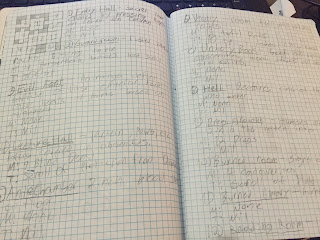
I'll end with some pictures of my "Nightwick Abbey Prototype" - the graph composition notebook I keep my dungeon notes in.


*It is some years old.

**It's a living dungeon that shifts when the PCs do things it doesn't like.


Monday, December 24, 2012

The Forbidden Palace of the Golden Emperor


It is said that since the Dawn of Man, a Golden Emperor has dwelled in the Forbidden Palace.   While obviously an exaggeration, it is true that parts of the palace complex date back to the first emperor to unify Cathay - perhaps even earlier.  Even through countless rebellions and the creation of a myriad of dynasties, for if anything true of Cathay it is that it seeks to break apart when it is whole and seeks to be whole when it is apart, an emperor has always lived there.  Even when the capital was moved during the previous dynasty, they took apart the empire palace and moved it plank by plan, stone by stone, golden throne by golden throne, to its new home in Winding Three Rivers.  

It is also said that each emperor that has lived their has gone mad, though some have been more mad than others.  His Celestial Majesty, the Golden Emperor of the World, Ruler of the Moon and the Sky, is madder than most.  Originally a rebel and a general, he grew aloof from politics after making himself emperor in the Red Blade Rebellion.  It is said that he murmured to himself while walking through halls at strange ours of the morning and began wearing a mask and gloves in order to avoid contact with contagions that he was sure surrounded him.

About ten years ago, he banished his entire court, including his concubines, wives, and children - indeed, everyone but his little lap dogs - from the palace.  Since then he has lived his life in a single room of the tallest tower of the outer wall.  His courtiers gather around the palace's moat each day carrying scrolls relating the issues facing the Kingdom That is the World.  He gazes at these with the aid of a spy glass and lowers his instructions down in a small basket.

The reason for the emperor's madness is the subject of much debate in the teashops and brothels of the capital.  Tradition holds that the ghosts of each emperor stay within the palace in order to advise their successors, though being mad themselves this advice is always poisonous to the mind. Others say that the various secret societies which truly run the empire have corrupted the emperor either with strange alchemy or foul magic.

In the years that have past since he banished his courtiers, the majority of the palace complex has gone into ruin almost preternaturally fast.  Knowing that even the guards have been banished, many rogues, thugs, and lowlifes have stolen into the ruins to abscond with the goods the treasures said to lie within.  Few have returned, and those that have have spoken of horrible creatures, rooms and corridors with unnatural dimensions, and fiendish traps that no previous record concerning the palace mentions.  

-----

The Forbidden Palace is meant to be the "campaign dungeon" of Cathay if I ever run it.  Quite a bit of the dungeon will be the upper works, but the complex stretches a good way below ground as well.  

Saturday, December 15, 2012

How Many Notes Do You Need?

The answer to the question posed in the title is, obviously, "however many works for you;" however, a recent post by Ian Burns on G+ has me wonder how many notes I need.  Ian posted a "confession" that he had spent three days making the entirety of his infamous Vats of Mazarin dungeon.  In total, he spent about 12 hours on the thing - which is more than I've spent on the first level of Nightwick Abbey at any one time, but the fact that he has multiple levels with roughly the same number of rooms has me wishing to improve my stocking efficiency.

When I first started running Nightwick Abbey  I used a hyper-minimalist map key.  I had even sparser notes than James used for his Dwimmermount game.  I typically only marked rooms that had monsters, traps or specials, and all the others didn't even have numbers placed on them.  I might write a sentence or two to explain a "special," but monsters and traps rarely got more than the number there were, the amount of HP they had, and how much damage they dealt.  I winged most of the other details on the fly, which usually worked out but eventually I would start to contradict myself.  In fact, part of the reason Nightwick Abbey might be sentient is that I wanted to explain why shit I had previously described was different.

I ended up changing my note-taking method when I started to run my version of Castle Greyhawk.  Since there were about 150 rooms on the first level, I needed to try harder to make them seem different from one another.  I also needed to be reminded more often of what those differences are, and so my keys started to get much longer and every room got its own entry.

When I started running Nightwick Abbey on G+, I adopted the same method I had used to note rooms in Castle Greyhawk.  I keep the key on a google doc and update the room descriptions every time the party changes something - assuming I remember to do so.  I also used this method when I stocked my Uz dungeons.  Here is an example of what it looks like:


A.2 Shrine of Manugal of the Setting Sun

1. Antechamber: This room is made of plain mud brick in the typical Uzite style and is not decorated in any way.  Along the north and south walls are several cages that once held human sacrifices.
Monster: None
Treasure: Nil

2. Outer Hall: The walls and columns of this chamber depict scenes of everyday life.  The city depicted, while Uzite, is actually Old Jerah.  The southernmost column depicts people being born while the northernmost depicts people being slaughtered.
Monster: None
Treasure: Nil

3. Inner Hall: Unlike the last chambers, this one is painted completely black, and it strangely appears to even dim light sources brought inside.  The columns and walls are completely smooth.  The only carved decoration is the massive statue of Manugal, made from a polished black stone of unknown origin.
Monster: None
Treasure: Nil

4. Sacrificial Chamber: Like area 3, this room is painted with a strange, black paint that seems to dim light.  Pillars are lined with strange, pale green stones.  If anyone is slain in this chamber the stones will light up.  Bones and dessicated corpses litter the floor.
Monster: 5 Vortlups (HP 7, 6, 8, 8, 10)
Treasure: 40gp, 4 pale-green gems (200gp each)
---

The problem with this method is that it takes me way too long to stock something. This is why I've become interested in Ian's Mazarin key. It seems to be a good middle ground between the two extremes that I've tried. It has just enough to allow me to remember what's supposed to be in there without having to design so much in advance that it takes me a month to work on a level.

Saturday, November 26, 2011

The City at the Center of the World


In the eyes of the people of the West, Zenopolis is a city without equal either in luxuriousness or depravity.  Its domed temples and tall spires are a testament to a bygone age: the age of the Empire.  When the barbarians swooped down from what is now Novgova into the Dark Country and the West, the Empire could do little to resist them.  Plagued by internal struggle and external invasion, the emperor Zeno moved his capital to an island city once used to as a fortress to defend against pirate attacks from the Desert Lands.  The Empire may have withered, but in the eyes of the people of Zenopolis some corneal of it still remains.

Zeno did not only move the capital.  He also revived the worship of the Old Gods.  While the Church of Law still exists legally, it does not hold the position it does in the west.  Instead, a cacophony of religions exist in the City at the Center of the World.  The Church claims many of these are diabolic in nature, and the clergy shudders to think what slithering things these deranged madmen worship.

Zenopolis's climate is arid when compared to the West, but the trade from the Desert Lands, the Dark Country, and places even farther than that have made it rich.  Its armies are filled with soldiers from across the World, though the Autocrat is particularly fond of using barbarians from the Dark Country as his personal guard.  Many of these men fled the lances of the Sword Brothers and found employment in the City.  It is sometimes said that the Autocrat's fondness for them goes beyond mere martial prowess, but most of the barbarians would staunchly deny this.  Such activity is unmanly.

Zenopolis is not the first built on this island.  Even before the imperial fortress, cities existed here.  The location is perfect for trade between the East and the West, and as such there has scarcely been an epoch where the island was uninhabited.  Rumors say that the ruins of these cities lie beneath the current edifices.  They intertwine and overlap creating a network of tunnels, chambers, and catacombs which could never be fully mapped.

In the days before the Church of Law, many of the temples possessed undercrofts and secret chambers that connected to these dungeons.  Since the revival of the Old Ways, many of these structures have seen renewed habitation; however, most still languish in obscurity.  It is said that when they were sealed, many of the priests and oracles were still inside.  What has happened to these populations in the thousand plus years since they were trapped inside is a mystery.

A more intriguing mystery, however, is what became of the golden idols and relics which were sealed in as well...
-----------------------------------------------------------------------------------------------------------

Recently, my mind has been filled with ideas for different games.  I was having a hard time picking one, but earlier tonight I decided to take the common elements and spin them off into their own project.  The above is a result.

Essentially, I wanted to make an EPT style Underworld that was heavily inspired by CAS's Zothique cycle; however, I don't want to abandon the work I've already done on the Dark Country and the World.  Hopefully, this is a good compromise.

The monsters will not be standard D&D fair but neither will they be LotFP creatures.  I'm not exactly sure what they will be yet, but I have some ideas.

Wednesday, November 16, 2011

Need a Megadungeon Idea?

How about Derinkuyu?

Assuming Google image search didn't lie to me, you even have a side view:


Edit:  Heres a better side view

click to embiggen

Unfocused Thoughts on the Hell-Caverns

Hercules in the Hell-Caverns is one of the least-recounted tales of that hero

While it's unlikely that I'll seriously develop another megadungeon in the near future, I thought I would spend a bit more time thinking about what I would do withe the Hell-Caverns.  There are three reasons I decided to go with the Hell-Caverns instead of Old Jerah.  First, the Hell-Caverns are much closer to my normal aesthetic, and therefore if I ever decided to run them I would be much less likely to experience the Gamer ADD that often overcomes me when I run things that aren't pseudo-medieval dark fantasies.  Second, the Hell-Caverns model offers a bit more flexibility.  It's much easier to imagine pseudo-Babylonian ruins in a dungeon beneath a medieval milieu than it is to imagine gothic ruins in dungeon beneath a Babylonian milieu.  Finally it fits better with the implied setting of LotFP.  

Here are some unfocused thoughts:
  • I'd probably place the dungeon near Conques since I have some familiarity with that region in the time period I wish to set the game.*
  • Narbonne might also work.
  • The wilderness around the caverns would mostly be populated with mundane encounters.  Robber knights, wolves, bandits, pilgrims, heretics, etc.
  • I might do separate encounter tables for day and night, with some small chance of encounter creatures from the nearest dungeon entrance at night.
  • Some of the upper dungeons will be the remnants of a monastery carved into the side of a mountain.
  • The caverns contain a mixture of medieval, Greco-Roman, Atlantean, snake-men, and old ones ruins.  Generally the deeper you go the older, and therefore more alien, stuff gets but there are isolated nuggets of the weirder shit in the upper levels.
  • I kinda picture this as the the Shaver Mystery during the Albigensian Crusade.  In other words: they'll be a shit-ton of heretics and morlocks.
  • Some areas of the caverns are miles across and are essentially lost worlds with their own ecosystems.  These will usually just have dinosaurs or ice age megafauna, but sometimes they'll have weirder things too.
  • I'd probably put more strange lights in the dungeon, rather than the pitch-blackness that clouds Nightwick Abbey.
  • CAS's Averoigne is once again a big influence (as is his Hyperborean Cycle).  Much like the Averoigne stories, many of the menaces will be Mythos (Smythos?) in nature, but the characters -- or at least the NPCs -- will contextualize them as Abrahamic demons.
  • If the Dark Country is my attempt to do Averoigne and Uz is my attempt to do Zothique then the Hell Caverns are all three of his big cycles pushed together.
That's it for now.  I'll possibly put up more later, but who knows?

Two Weird Fantasy Megadungeon Ideas

Old Jerah: Once the City of Mot, the One Who Pulls into His Gullet, now all that is left of Old Jerah are broken buildings and its supposedly endless catacombs.  When the priest-kings of Jerah ruledit was known as a place of great terror, and all slaves and soldiers feared becoming the next sacrifice to the Black God of Ghouls.

Then, if accounts are to be believed, the demon Li-Lit appeared in the temple of Mot and slew his priests and the Priest-King himself.  Only the women of Old Jerah, which was famous for it's misogyny even among the harem managers of Almodad, survived.  They fled the ruins and founded the city that men currently call Jerah and set there a black temple dedicated to the night demon that freed them.

Since then Old Jerah has lain in ruins.  The merchants who travel in caravans that pass near the outskirts of the necropolis tell dark tales in the taverns.  They whisper of inbred degenerates, hyena-headed ghoul-priests, and strange lights that dart about the ruins.


The Hell-Caverns: In the eons before humankind walked the earth far stranger races built towered cities on the great continents of the world.  Great were the heights they reached, and even greater were the cataclysms that crushed their palaces beneath the earth.  Many were their names and numbers, but all these are lost to humankind's memory.  Their forms too were numerous, and they can be guessed at from their degenerate descendants that often dwell in the deep places of the world.

One such place lies near a small town in the Languedoc region of France.  The rocky landscape hides a vast network of caves and ruins.  Many of these ruins were built by humans in some forgotten epoch when fair Atlantis or distant Mu were in their infancy.  Some are older still, built by slithering things with alien masters.  These creatures wielded magic and technology beyond the understanding of men.

Those that have gone in the caves seldom speak of their experiences.  Those that do often are cleansed with holy fire by the Church, for what they say questions the nature of humankind and its centrality to God's universe.  Some even question the existence of God, pointing to the unquiet things that lurk in the dark as evidence that some far more strange power than Him governs the universe.  Those that can be bothered to stop their heretical babbling do tell of glittering gems and items of wondrous power, but their usually shuffle off this mortal coil shortly thereafter.

Thursday, November 10, 2011

Nightwick Abbey and the Philosophy of Raggi's Game


Let me start by saying I wouldn't describe Nightwick Abbey or the Dark Country as "weird."  According to Beedo's taxonomy of horror the Nightwick Campaign should fall firmly into the Supernatural Horror camp.  While the Church of Law is a bit too hierarchical -- some might say fascist -- to be truly considered good in the context of modern, Western society, it is somewhat admirable in its eternal struggle to hold back the creatures of the Pit.  In light of the fact that the greater evil is, in fact, Satan, the God of Law and his followers more or less fill in the "good" niche.  The setting is intentionally filled with a mix of Judeo-Christian and Gothic imagery, even if that imagery is filtered through metal album covers.

But there is a reason I picked Lamentations of the Flame Princes: Weird Fantasy Roleplaying as my preferred system for the setting.  The primary reason is that the players' part of the rules is almost a perfect fit.  The classes work not only the way I want them to on a mechanical level, but also on a flavor level.  This is especially true of Magic-Users.  On a more petty level, I'm generally a fan of Ascending AC and I enjoy the fact that any class can wield any weapon or wear any armor, but these reason pale in comparison to the way that the overall flavor of the rules meshes with my vision of the game.

At least on the players' side of the screen.  I'm not as comfortable with some of the advice for the GM's side of the screen, or rather I'm not as comfortable with it for what I want to do right now.  The two key points of tension are monsters and magic items.  Raggi, rather famously, doesn't like standardized monsters, and I agree with him, up to a point.  Where it becomes a problem is in the stocking of a megadungeon.  Now, I've already established that I don't mind non-standard monsters.  Quite the contrary.  I feel that a diversity of such terrors can greatly improve the quality of one's megadungeon.

Herein lies the problem.  In Raggi's conception of the game, as I understand it, monsters are only an occasional threat.  Of course, when they do show up their supposed to be horrible and memorable.  This model doesn't seem to fit terribly well with my vision of Nightwick Abbey.  It certainly doesn't fit with the campaign I ran with my face to face group.  I'm afraid I'm probably not creative enough to come up with an plethora of completely unique creatures to haunt the abbey, and it just isn't the sort of place where humans are terribly common.  I suppose I could use Raggi's own Random Esoteric Creature Generator, but the results would by and large lack the themes that make the Abbey what it is.

Magic items are more of an issue of practicality than anything else.  I've pitched this as a FLAISNAILS game, and some of the incoming PCs are undoubtedly going to have magic weapons and armor of the simple +X variety.  What is easier: stocking my dungeons in a way that makes those characters consistent, or coming up with some sort of houserules to change those items to be more thematically approprate?  What happens if someone gets one of Nightwick Abbeys LotFP style magic items and then takes it over to Wessex?

Still, his ideas are not without merit.  Last night I decided to read the example of play in the tutorial book on a whim.  I'm generally a fan of such things, and I'm especially fond of the one in Empire of the Petal Throne.  Raggi's did not disappoint.  While I'm not entirely sure this was the purpose, it reminded me of the more exotic works of Clark Ashton Smith.  Specifically I was reminded of "The Weaver in the Vault" and "The Tomb-Spawn."  Both of these can more or less be described as TPKs in short story form.  They're also among the few dungeons, in the D&D sense, that I've seen in literature.

When I think about D&D, I usually have one of CAS's worlds in the back of my mind.  For the Dark Country, Averoigne is undoubtedly the most important of his milieus; however, the above two stories and "The Tale of Satampra Zeiros" have profoundly affected the way I view dungeons and D&D in general.  When I say that Raggi's model reminds me of those stories I mean it as the highest form of compliment.  I must say that I am interested in trying it out in a Smithian context.

So while the G+ version of Nightwick Abbey will not follow his conventions, that doesn't mean that future versions will not.  I may try to find a way to wed the two together, or maybe it would be more interesting to think about what kind of campaign dungeon I would develop if I took Raggi's philosophy entirely to heart. Perhaps something like the catacombs of Chaon Gacca.

Sunday, November 6, 2011

Treasuredeep


Since I did a pitch for the Wild Lands, I thought I'd do one for Treasuredeep.  I originally made to test out the excellent "game" How to Host a Dungeon.  My wife gave me the name.

The premise: Many dwarf years* ago, a clan of dwarves sought to build a great hall in a land they knew to be rich in mithril.  For many years they toiled in the rock, and from the ore they made many wondrous items and fabulous treasures.  Under the Hammerhand kings the dwarves of Treasuredeep entered a golden age.  Songs from this time are still sung by dwarves everywhere.  These songs tell of great battles against the goblins, of magic swords of terrible power, and of large-breasted mustachioed dwarven maidens.

They also tell of the sad fate of the Hammerhand dwarves.  It is said that one day while expanding their hall, the dwarves tunneled into a series of caves that housed the Wyrm as Old as Time.  It slew many dwarven warriors and drove them from that section of their mine.  In the many years that followed, the Hammerhands led campaign after campaign into the caverns in a desperate attempt to win back the treasures of their fathers and to slay the Wyrm for good and all.  Alas none where ever successful, and it is said that the last members of the house of Hammerhand who were still alive led a suicidal charge into the dragon's den, never to be seen again.

In the time since, the Realm of man has spread over the surface, and the races of dwarves and elves have slunk to the dark corners of the world.  Now a town of men lies near the most famous entrance to the abandoned mine.  Rumors say that the Wyrm as Old as Time has slept for the (human) centuries since it ate the last king.  They also say that new residents now lair in the old mine, and they are much less friendly than dwarves.  Still, if legends are true their is a fortune in that old mine, and you're just the PCs to get it.

How this works:  This one would be much closer to Myrddin in design.  Each session is a discrete delve into the dungeon with a randomly selected party roster.  The dungeon itself would be a mixture of geomorphs and my own hand drawn maps.  Most areas will have a definite theme determined by the results of the How to Host a Dungeon game.

Like the Wild Lands, this campaign concept is vaguely inspired by the Hobbit; however, I think this one would be a bit more gonzo.

I may work up a similar pitch for Nightwick abbey, but I imagine most of my readers are familiar with that dungeon.  In session format, it would more or less work the same way as this one.

* dwarf years are much longer than human ones and are based on tectonic processes rather than the movement of the sun.

Friday, November 4, 2011

G+ Nightwick Abbey Polls

I've added two polls so that my readers can help me decide how to run a ConstantCon game I'm planning.  My model is entirely stolen from Jeff's Wessex game.  Mine will take the players into the dungeons of Nightwick Abbey.

The first question I had was which rules y'all would most like me to use.  I'm quite partial to LotFP, though I'll be adding a customized bestiary in order to more easily facilitate megadungeon exploration.  Still, Jeff's game uses B/X and I imagine that there will be some crossover in players.  As such, I thought I'd open up Labyrinth Lord and B/X as options in order to assure maximum compatibility.  Select the one you would prefer.

The second one is to help me decide when I should run the game.  I've noted times that are particularly good for me (this semester).  Select any of the ones you could potentially make.  I'll pick the one that gets the most votes.  This time might be subject to change next semester depending on how my work hours shake out, but I tried to pick times that wouldn't bee in too much jeopardy.

You have one week to vote.  Post comments here if you have any.

Wednesday, October 5, 2011

Every Man's Dungeon is His Castle

At the end of Tuesday’s session (report coming soon) my co-DM attempted to give out a hook for the nearby village of Hommlet.  When he did so one of the players objected.  It seems that he has been waiting anxiously for the day that he could run the Temple of Elemental Evil, and so we agreed that he could do so if he wished.  Then my wife expressed interest in making a dungeon and running it.

Thinking about it today, I was reminded of a section from EPT wherein Barker states that eventually players should make their own underworlds and cities in the world of Tekumel.  I've always been fascinated by the concept, and now I see the potential to enact it.  

Here is my idea:  any player who wants to DM should either pick a large module or make a big dungeon of their own.  They should place it somewhere on the map below.

click to embiggen

Once placed, the player should detail the wilderness area around the dungeon itself (the area contained in the square).  The DMs should come up with some common assumptions and a skimpy setting bible so that reality doesn't shift too greatly, but within those parameters one has complete control over what goes on in his or her square.

The player should make two rumor tables.  One will be rumors about their dungeon, and the other will relate to the surrounding wilderness.  These will all be combined on one large table that every DM will use when the players go in a tavern.  I may suggest a system that would cause the rumors gained to skew towards those areas which are close by, but that is up for debate.

Whenever the characters are headed to your square, your character stays behind to handle party business in the other areas.

While I think it'd make sense for me to get Greyhawk and its environs, I'm willing to give it up.  Nightwick abbey seems like it would fit in well in the Shield Lands...


Monday, September 19, 2011

Nightwick Abbey in Hindsight Part 2


Part 1

Before I discuss my future plans for Nightwick Abbey and the Dark Country, I need to establish what I think "worked" with the Nightwick Campaign.  Despite my inability to get the dark tone across through my descriptions, the things in the abbey itself were significantly weird enough that they elicited the desired effect from my players even when my descriptions failed to do them justice.  A prominent recent example was the mite spawning pool which occupied much of the player's time due to their curiosity about its function and nature.  The sense of weirdness pervaded nearly every session in which they went into the dungeon.

I will be working some of this into Greyhawk castle.  Greyhawk will definitely be weird, but in a more artificially constructed way.  Much of the weirdness behind Nightwick Abbey was due to the fact that the dungeon acted not unlike a cancer, constantly adding new tumorous rooms and passages onto itself.  Since Greyhawk is a more stable structure its weirdness comes from the maniacal will of its creator.  It will also lack my characteristic love of spontaneous generation as the ecological explanation for dungeon monsters.  I think some of the more hard core AD&D players were a bit put off by the fact that my orcs did not mate in the usual fashion, or that these weird "mite" things had replaced the more familiar kobold.  For the most part this displeasure manifested in eyebrows being raised before they engaged with the weirdness on its own terms, so I definitely still consider it a positive.

While I'm discussing how it informed my ideas about Greyhawk, I should note that some of the specials and maps I had planned for Nightwick Abbey will probably get lumped in with my Greyhawk project.  If I am to run the abbey again for this group, it will likely mean that some of the lower levels of the dungeon will need to be retooled in order to prevent repetition.  Admittedly, the amount of these specials that are usable is quite small due to the differing nature of the two locales.  Ultimately though, Greyhawk is a side show for me.  While I plan on running it indefinitely, my true baby is Nightwick Abbey and as such I'll be taking a great deal more shortcuts with Greyhawk in order to facilitate more work on the Dark Country.  Of course, Greyhawk might capture my attention as I continue to work on it, so I'm willing to let it take over if I get inspired.

As for the abbey itself, I have a couple of thoughts swimming through my mind.  One is inspired by my return to reading C L Moore's Jirel of Joiry stories.  The underworld she describes was a fairly early inspiration on the dungeon, and I think it might be neat to include a few more "natural" chambers.  In this model, the Abbey sits on top of its stores that sit on top of its dungeons that sit on top of a sprawling cavern system with its own ecology and natural laws.  Sort of a micro-underdark with a more Satanic bent.  I will note that I may avoid this if I redesign the dungeon because it muddies the water a bit when it comes to the abbey's origins.

What I know I'll be doing is drawing a sharper contrast between the tone of the Dark Country as a whole and the tone of the area beneath the Abbey.  The Dark Country itself is filled with werewolf haunted woods and cursed mountains.  The country itself is filled with a terror of what moves just beyond one's vision.  The Abbey on the other hand should have more of an emphasis on the "weird."  It is a place that vomits up obscene forms that writhe and skitter about its halls.  While both obviously represent a horrific setting, there is something palpably different about the two images and I think that the dungeon becomes better once one draws a clear line between the underworld and the "overworld."

Lastly, I plan on developing the upper works a bit more.  Much of the inspiration for Nightwick Abbey came from images of Brick Gothic structures in the Baltic, and the only reason I did not include more detail on the ruined pile was a time constraint.  Coincidentally, Greyhawk castle is really just a tumbled bunch of stones over the dungeon rather than a locale in its own right.  I may change that if time goes on (and the players permit).

Since this one went a bit long, I'll discuss future venues for the dungeon and the original inspiration in part 3.

Sunday, September 18, 2011

Nightwick Abbey in Hindsight Part 1


Due to the approach of Halloween, which I spend much of my waking time anticipating, and due to the beginning of my co-DMed Greyhawk campaign I've been thinking a lot about Nightwick Abbey.  Despite the fact that my campaign, for the foreseeable future will not deal with that demon haunted church, it's still the epitome of what I do when I do D&D.  As such, I'll be continuing my work on it's several levels and environs in anticipation either future campaigns, G+ one offs, or some other as yet unforeseen medium for the dungeon and its setting.

I've largely created my version of Castle Greyhawk (built by Vennax the Mauve instead of Zagyg) as a reaction to Nightwick Abbey.  Greyhawk is actively designed to be different from its predecessor.  It's a great deal sillier in tone and relies a great deal more on "traditional" D&D monsters such as kobolds.  I've also placed a great deal more emphasis on different factions within the dungeon.  The ultimate adversary of the Nightwick campaign was the abbey itself.  The monsters inside were expressions of the Abbey's sinister will, and as such it was quite difficult to reason with them.  In Greyhawk, the monsters and dungeon NPCs are motivated by the same things that motivate the PCs: greed and survival.  This is a function of the events that created the two dungeons.  Nightwick Abbey's walls are soaked with the evil of its previous tenants while Greyhawk is instead a funhouse created by a mad wizard for his own amusement.

The twenty-five sessions the Nightwick Campaign ran exposed some weaknesses in my preparation and presentation.  The primary one was that I was under-equipped to deal with adventuring outside of the abbey. While I'm sure no one would fault me for still struggling with the Dark Country map, I still have have only a faint idea what Lichegate is like, despite the fact that the PCs visited it numerous times.  One can obviously point out that such things should be decided through play, but I failed to have enough of a skeleton on which to hang such information.

I also think I failed to correctly convey some of the atmosphere I wanted.  While many commentors have noted that my write ups for various Dark Country things are evocative, this largely failed to come across at the table.  This is at least partially the result of things beyond my control.  Our play time is very limited (only about  two and a half hours) and theres also a lot of bullshitting at the table.  Since gaming is a social activity I see this bullshitting as part of the point, but it does demand that I cut down some of my descriptions and leave out certain bits of town descriptions in order to cut to the dungeon.

This necessity especially became noticeable by sessions 23 and 24 about half of which took place in the village, to the disappointment of some of my players.    I emphasize the word "some" because at least one of my players was more at home outside the dungeon, even if the majority seemed to prefer skulking down its benighted halls.

The other problem lies partially with my inability to accurately describe things.  Part of this was (initially) nerves, since I was uncomfortable doing my terrible English accents in front of people I barely knew at the time, and part of it was general incompetence on my part.  The first problem has more or less been rectified, while the second persists.  I believe I shall have less difficulty with Greyhawk, which is a bit easier to wrap one's head around.

The final problem was the lack of treasure available in the dungeon.  While there were certain points when I felt random generation had given the players magical items beyond their level, the lack of monetary treasure was a major hindrance to advancement.  I used the Labyrinth Lord/AD&D treasure tables by the book, including treasure per individuals vs. hoards.  My change away from that is due to the fact that the players were still hovering around level 2 and 3 after 25 sessions.  I tend not to pull punches, to paraphrase my current co-DM, and the increased treasure created by the new method should help to mitigate that fact.

Thus ends part 1.  In Part 2 I'll discuss what I think I did right, the future of the Abbey and its dungeons, and the original inspiration for the project.

Monday, September 5, 2011

Stocking Castle Greyhawk

As of yesterday, I have completed the maps for the first three levels of Castle Greyhawk, ignoring sublevels and the surface ruins.  I thought I'd go over my stocking process since it's a bit different than the one I used for Nightwick Abbey.  It primarily comes from reverse engineering random dungeon generation charts in the DMG, with a bit more standardization.

First, I fill up a hole punched 8x11" piece of graph paper (about 5 lines to 1") with dungeon, trying to squeeze in as many rooms and corridors as possible.  This will usually constitute one level.  I've based this on Gary's maps, seen below:

click to embiggen

While it's entirely possible that more than one of these make up a level, I decided to stick to the one sheet = 1 level rule that I used for Nightwick Abbey simply because in 25 sessions the party never even came close to mapping all of the first level, let alone the ones beneath it.  I figure that if I need more, I can add it later and explain it away fairly easily.

Unlike Gary's maps, I tended to use straight corridors and square or rectangular rooms.  As Jeff noted in an earlier post, odd shaped rooms are usually more of a headache than they're worth.  This isn't to say there are no oddly shaped rooms in the dungeons beneath Castle Greyhawk, just that the majority of the rooms are easier to describe to a mapper.

But enough about mapping, this post is about stocking.  First, I guesstimate a sheet of graph paper to be able to hold c. 100 rooms.  I have no idea how accurate this is, and I don't really care.  I've broken down the stocking chart (Table V. F. on page 171 of the DMG) into the following:


  • 25 rooms will have monsters
  • 5 rooms will have "specials"
  • 5 rooms will have traps (I include "tricks" as specials)
  • 5 rooms will only have treasure.

I generate the monsters randomly using the charts in the DMG and a few monsters from the FF to spruse things up a bit.  I will say that by and large Castle Greyhawk relies much more on the MM than Nightwick Abbey did.  I want this to feel appreciably different, and so I've decided to go to a bit more into traditional D&D territory.  I'll still be sticking in some gorbels and grells though, don't you worry.

After generating the monsters, I generate treasure.  To do this I ignore the treasure "per individual" -- only using that for wandering monsters -- and instead always generate treasure as if the monster were in its lair.  For an example, a group of 6 elves would generate G, S, and T type treasure.  This treasure is not assigned to specific monsters yet.  Instead I tally it all up together, generating magic items, gems, and jewelry accordingly. After the incident with the Staff of Power in the previous campaign, I've been a bit more selective with magic items.  I've more or less stolen this system from Scott and use it for more or less the same reason.  I hope that it will help keep advancement at a smooth pace despite the amount of death typically seen in my dungeons.

Finally, I place the specials I've developed.  These include weird things like the Talking Tomb from Nightwick Abbey or complexes controlled by dungeon factions.  If new monsters are required, their hp and treasure are generated now.  These treasures are added to the total pool.  I then distribute these first, placing in them an amount of treasure that is proportional to their difficulty.

Next I distribute the monsters in a way that makes sense to my deranged brain.  This is usually done by just eyeing the map and trying to make sure rival monsters don't live too close together.  This will have increased importance in Castle Greyhawk because I plan to place considerably more emphasis on dungeon factions than I did with Nightwick Abbey.  I then distribute the treasure among these monsters in a way that makes sense, leaving a little to be put into trapped and empty rooms.  Next I place traps in places that make sense, followed by the treasure that goes with it.   Then I place the remaining treasure.

That's more or less it.  I do sublevels a bit differently (a bit more like regular lairs), but this is how I do the vast majority of the dungeon.  I may do a post on the different factions in the dungeon, or at least the first three levels of it, shortly.

Friday, August 12, 2011

What do you think it says?

click to embiggen

I'm not the first person to post this picture or to notice the oddness of his key.  Rob Conley has discussed minimalist dungeon keys before and my notes more or less look like what he describes, but they're verbose compared to what Gygax has in front of him there.  So my question to you is, what the hell could those say that would allow him to run the whole level?

this blowup doesn't help

It's interesting to note that he more or less does what I've been doing with Nightwick Abbey: he fills a sheet of graph paper full of rooms and corridors until they won't fit anymore.  Mine isn't quite as crowded, but it looks like more or less the same scale of graph paper (6 to 1").  This makes the fact that he can run it with so little even more perplexing to me.

Someone in the comments of one of Jeff's old posts suggested that those maps -- which are very similar and also from Gygax's hand -- might only list "important rooms" but that seems strange to me since it's not like this is In Search of the Unknown where the DM is expected to fill out the rest.  This is it being run by a DM.

On a tangentially related note, I've been working on some new maps for Nightwick Abbey and I'll try to post some pictures of the first three levels in the next few days.

Monday, August 1, 2011

Google+ and Campaigns


Many of you may remember Jeff Rients's 2007 post What is a campaign?  In it, he provides a model which is by and large dead.  However, it doesn't have to be.  While reading over Rythlondar it occurred to me that the player base just doesn't exist anymore for that kind of game.

Except it does.  We have Google+ now, and Constant con.  Imagine a world where every OSR community blogger either runs their own campaign dungeon or setting that everybody else plays in from time to time.  It's admittedly a bit far fetched, but I will say it would be totally awesome.

Thursday, March 31, 2011

Stocking a Postapocalyptic Sandbox and a Map

These Charts more or less utilize Welsh Piper's Campaign Hexagon System, but are more tailored to Postapocalyptic nonsense.  If you're using Gamma World or Mutant Future, you might want to stick to the basic ones found on his site.  These are intended for games where technology has not quite devolved that far.


Major Encounters
1 – Town
2 – Fortress
3 – Bunker
4 – Ruin
5 – Mutant Lair (Large)
6 – Special Hazard

Minor Encounters
1 – Village
2 – Ruined Structure
3 – Isolated Homestead
4 – Fort
5 – Wandering Mutants
6 – Mutant Lair (Small)
7 – Camp, Industrial
8 – Camp, Semi-permanent
9 – Ancient Structure (Mostly intact)
10 – Natural Hazard
11 – Infrastructure (Sewer, roadway, etc.)
12 – Battlefield
13 – Cache (1d6: 1-2 Weapons, 3-4 Food, 5-6 Books or other intellectual goods)
14 – Contested Area
15 – Construction Site (1d6: 1-2 Settlement, 3-4 Fort, 5-6 Landmark)
16 – Cave System
17 – Fallout Shelter (30% chance of having pre-war valuables, 60% chance inhabited)
18 – Religious Structure (1d6: 1-3 Church or Temple, 2-4 Graveyard, 5-6 Pilgrimage site)
19 – Special Hazard
20 – Meeting place

I will note that I'm not as comfortable with the second table and I'd like someway to increase the chance that "ruins" show up, but what can you do.

click to embiggen

This map is what I hope to use the stocking tables with.  I've already determined the number of minor and major encounters, I now just have to figure out what they are.  

The map itself is based off of East Tennessee and the surrounding areas.  Each hex is roughly 10 mi, but the spacial representations are not entirely accurate.  The two ruined metropolises are Knoxville (my current place of residence) and Chatanooga.  It supposes a nuclear war, followed by a nuclear winter, followed by a nuclear summer, followed by global climate change ending in what is more or less an ice age.  Sprinkle on top of that massive pre-war pollution and you have a cold, acidic hellhole of a place.  Still it's better than what's to the West of it.

I'm still looking for a system to express this setting in, but I hope to have one soon.  I'll probably steal the premise of the Morrow project even if I don't use the rules, though with slight modifications of course.

Thursday, March 10, 2011

Would you play a Priest?

I recently posted both an overview of the class and a lists of the "gifts" associated with Apollo.  I want to know if I've made them too undesirable.  I personally would only play priests in such a campaign, but I'm kinda a weirdo.  My wife has expressed that she feels otherwise.

So what do you think: would you play a priest in an Underworld campaign?  If not, why not?

Sunday, February 6, 2011

Dungeon Stocking

Somewhat inspired by this post at The Lands of Ara, and somewhat inspired by the fact that I'm currently stocking some levels of Nightwick Abbey, I've decided to spend a bit of time talking about how I go about creating the various levels of my campaign dungeon.

The first thing I do is slap together geomophs in a pattern that roughly fills up a 6 to 1" sheet of graph paper.  This usually takes about 20 geomorphs laid out in a rectangle (5x4).  I make sure to get them from varied sources, but I prefer the ones that make their geomorphs available in pdf form.  If possible I prefer to do things by hand with pencil and paper and cut out geomorphs as opposed to computers.  As I copy them, I fix dead ends, cap the ends, and otherwise change the layout to make more sense as a cohesive level.

Here is a now outdated map of the second level.  I made this one using MS Paint, and it fits a full 8 to 1" piece of graph paper, and therefore is considerably smaller than my current dungeon plans.

click to embiggen

Then I set about stocking the thing.  I estimate that a dungeon of that size is roughly 100 rooms (it's sometimes more and sometimes less) and use the LL percentages for dungeon stocking to figure out what the rooms should contain.  I tend to fill in the "specials" first, but if I don't have any in mind I usually start with groups of monsters.

To do this, I use the "Dungeon Random Monster Level Determination Matrix" found on page 174 of the DMG.  I then roll on the appropriate chart in the Fiend Folio to determine what monster inhabits a room.  I reroll any results make since for the individual level until I get one that does make some semblance of sense.  I use the Fiend Folio charts to determine the number of monsters, raising the die number as appropriate for deeper levels.

I take the results down in short form on a piece of paper.  Then I go about placing traps of various sorts and the treasures associated with otherwise empty rooms.  After I've come up with all the possible monsters, treasures, traps, etc.  I place them in whatever rooms on my map seem appropriate.

Last, I come up with a random encounter chart for the dungeon level.  To do this I take the Random Monster Level Matrix and associated 6 different monsters with each result.  So if a random encounter shows up, you roll 1d20 to determine its level and then 1d6 to determine the individual monster.  Occasionally I'll associate an especially unique monster with a random encounter instead of the an individual room.  If the monster is slain, its result is replaced with a more common dungeon foe.

So that's more or less how I stock.  I occasionally use the RC or the Mentzer Red Box as well, though I tend to stick the DMG, FF, and LL.